
Fraud Blocker April 2026 Growth Index Report : A new study from the Saltus Partnership Programme and LEK | Saltus

Growth Index Report

April 2026

Share this article:

Growth Index Report A new study from the Saltus Partnership Programme and LEK

April 2026

Share this report:

Foreword

Our intention is to report the views of senior financial advisers each year, so that over time we present a map of how the sector has evolved.

This is the year that the dog did not bark. What might have been a year of market led trauma, following reaction to Trump’s imposition of tariffs, did not happen. Indeed, markets have taken continuing geopolitical instability in their stride and, perhaps as a result, our respondents are reporting some confidence about the year ahead.

However, there is no room for complacency. Financial planning firms are operating against a drumbeat of regulation, which adds cost and complexity to their businesses. And a challenge for many, particularly smaller firms, is how senior leaders can juggle multiple roles. This is a problem which will get worse before it gets better. There is a clear recognition among respondents that technology and AI more generally represent substantial opportunities to improve efficiency and profitability, but acting as CTO as well as CEO is not a challenge most respondents embrace with relish.

Moreover, there are some indications, as yet still small, of underlying market changes, which may affect the shape of firms in the future. There is widespread reporting of at least some clients leaving the UK.

That said, it would be wrong to be too gloomy. Overall, the report paints a picture of a sector in good health, populated by talented executives, aware of the opportunities and challenges and with the appetite to address them.

Our thanks go to the many busy people who took the time to complete the survey. We wish all our colleagues in the industry well and we hope you enjoy this report.


Executive Summary

This inaugural Financial Planning Growth Index report provides a comprehensive overview of the current state and future outlook of the financial planning industry. It highlights key developments, challenges, and priorities for firms as they navigate a complex operating environment – with a particular emphasis on growth. Despite this backdrop, our respondents are confident that they can tackle these challenges and make the most of the opportunities that await them in the next 12 months and beyond.

Momentum builds across the sector

Confidence in revenue growth has strengthened, with 74% of financial planning firms feeling confident about increasing revenue over the next 12 months. This compares with 70% in the last report, based on data collected in Autumn 2024. This improved optimism extends beyond individual financial planning firms. Expectations for the whole market have shifted upwards, with 39% anticipating 5-10% growth in sector wide assets under advice (AUA) and 21% forecasting 10-20% growth compared with just 12% in 2024. Firms believe a critical driver of this will be client inflows, which will remain strong. 34% expect inflows to exceed outflows by 10% or more.

Confidence under pressure

Despite this positive outlook, financial planning firms are still operating under considerable strain. Regulation and compliance remain the most significant challenge, cited by 26% of respondents. Economic uncertainty has become a greater concern since the previous report and political intervention and rising operational costs continue to raise concerns. These external factors are compounded by internal pressures. The multiplication of roles and responsibilities has become a defining feature of financial planners’ working lives, with many now carrying additional duties beyond what they see as their core job.

Levels of preparation remain broadly steady at the middle of the scale. However, the proportion of financial planning firms describing themselves as well prepared has fallen and none describe themselves as very well prepared, compared with 4% last year.

Organic growth remains king

Growth continues to be driven primarily by organic activity. Referrals and networking remain the most influential source of expansion, cited by 31% of financial planning firms and consistent with last year’s report. Market performance remains a significant contributor to asset growth, while partnering with third parties is gaining recognition as a practical way to scale without stretching internal teams. Acquisition remains limited across the market at 4%. Larger firms continue to use this lever more than others, although their reliance on acquisition has softened compared with the previous survey.

Clients remain steady in their priorities

Reported client needs remain anchored around long term planning. Estate and intergenerational planning and retirement planning each account for 31% of client priorities, identical to last year’s report. However, smaller shifts are emerging. Interest in relocating abroad has increased modestly while concern around school fees and the cost of living has reduced slightly. Cybercrime is becoming a notable point of discussion with many respondents reporting that at least some of their clients have been affected. Relocation is also becoming a regular feature of planning conversations. Nearly half of financial planners report that a number of their clients (between one and five) have moved abroad in the past year.

Technology

42% of respondents identify technology investment as the most important contributor to future efficiency. Upgrading existing systems remains the leading priority, with financial planning firms increasingly directing investment toward artificial intelligence (AI). Firms see AI delivering greatest value through administrative streamlining and planning support rather than influencing portfolio decisions. AI is being adopted in ways that build capacity and reduce operational pressure without altering the adviser-client relationship. 70% of respondents expect staffing levels to remain unchanged, signalling broad consensus that AI is augmenting, not substituting, human expertise.

Resilience will define the next five years

Looking ahead, financial planning firms expect the next five years to be shaped by many of the same forces they face today. Technology and AI developments are seen as the most influential drivers of change, followed by regulatory development. Concerns about the supply of financial advisers persist but are slightly reduced compared with the last survey.

Rising confidence in a challenging climate

Confidence is improving and financial planning firms across the market are backing themselves to grow in the year ahead.

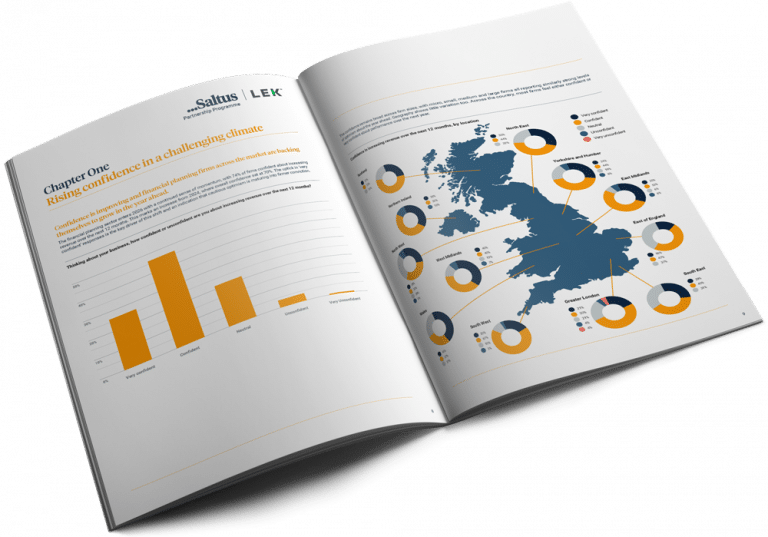
The financial planning sector enters 2026 with a continued sense of momentum, with 74% of firms confident about increasing revenue over the next 12 months. This marks an increase from 2024, where overall confidence sat at 70%. The uptick in ‘very confident’ responses is the key driver of this shift and an indication that cautious optimism is maturing into firmer conviction.

Thinking about your business, how confident or unconfident are you about increasing revenue over the next 12 months?
Reset


This confidence remains broad across firm sizes, with micro, small, medium and large firms all reporting similarly strong levels of optimism about the year ahead. Geography shows little variation too. Across the country, most firms feel either confident or very confident about performance over the next year.

Confidence in increasing revenue over the next 12 months, by location
  • Very Confident
  • Confident
  • Neutral
  • Unconfident
  • Very Unconfident
map of scotland
map of north uk
map of south east uk
map of south west uk
map of northern island
map of UK

Expectations for growth of Assets Under Advice (AUA) have also strengthened, with more firms forecasting growth in their own business towards the upper end of the spectrum. 19% expect AUA to grow by 0-5% and 29% expect growth of 5-10%. A further 28% anticipate increases of 10-20% and 8% believe growth could reach 20-30%. These expectations do not appear to be led by size of business with all respondents demonstrating confidence in achieving double digit increases. This marks a shift from 2024, when larger firms disproportionately forecast growth of 10-20%. Negative growth expectations have also diminished, falling to between 2 and 4%, and notably no large firms foresee declining AUA.

How fast firms expect their AUA to grow over the next 12 months, by firm size
Reset


Sentiment regarding the wider financial planning market follows a similar trajectory, with a growing proportion now anticipating stronger performance across the sector. 19% of firms expect whole of market AUA to grow 0-5% while 39% expect 5-10% growth. Notably the proportion forecasting double digit growth has nearly doubled since 2024, rising from 12% to 21%. The majority of firms expect AUA to grow 5-10%, however.

Expectations for inflows versus outflows are an important driver of this confidence. A majority of firms believe that inflows will exceed outflows with 34% anticipating that inflows could surpass outflows by at least 10%, while 23% of respondents expect a margin of 5-10%.

Expectation of total market AUA growth in the next 12 months, by firm size
Reset


A sector adapting to rising challenges and uncertainty

Financial planning firms are becoming increasingly optimistic, even as operational strain continues to build.

Yet this rising confidence sits alongside unmistakable signs of operational fatigue. Regulation and compliance continue to be the most significant concern for financial planning firms. 26% of respondents cite regulation as their primary challenge, similar to the 29% recorded in 2024. Economic uncertainty has increased notably, rising from 14% to 20%, reflecting the shifting macroeconomic backdrop and its effect on client sentiment. Political intervention remains a material concern at 16%, although down from 20% in the previous survey. Rising operational costs continue to place pressure on margins and resources at 15%, compared with 19% in 2024. The overall profile of concerns is broadly unchanged from the previous report.

Thinking about the future growth of your business, what do you see as the principal challenges?
Reset


These challenges are compounded by the number of roles financial planners are being required to take on. Many report that they are wearing far too many hats, with 80% identifying primarily as financial planners while simultaneously taking responsibility for additional functions. 41% say they also act as Chief Compliance Officer, 28% take on technology leadership and 26% run HR or marketing activity. This level of “role creep” presents a structural challenge to both capacity and quality, reducing the time available for client work and strategic planning while potentially increasing operational risk.

Which roles do you have to fulfil in your business due to limited resources?
Reset


Despite these challenges, levels of preparation remain relatively stable, although slightly softer than 2024 at the upper end. 60% of respondents feel moderately prepared to manage the challenges ahead, compared with 49% in the previous survey. 23% feel well prepared, down from 33%, and 15% feel only slightly prepared. 2% report feeling unprepared, which is unchanged from 2024. While preparedness remains moderate, the shift away from respondents reporting that they are well or very well prepared suggests that firms are managing but under growing strain.

Firm preparedness to handle challenges
Reset


Moreover, financial advisers also express concern toward the Government’s proposal to require pension funds to allocate more capital to UK listed companies. Only 19% of respondents support the proposal. 38% remain neutral, while 23% oppose it and 17% strongly oppose it. For many financial planning firms, the proposal represents yet another layer of intervention at a time when regulatory and operational demands are already substantial. This cautious sentiment reflects respondents’ worry that additional constraints could limit investment flexibility and add further pressure to an already strained system.

The engines of expansion

Partnerships are becoming more important and technology is evolving, yet organic growth remains king.

Growth continues to be driven primarily by organic activity, supported by a more intentional set of strategic levers. Referrals and networking remain the dominant driver of growth cited by 31% of respondents. This is almost identical to the 32% recorded in the previous survey, confirming that relationship driven client onboarding continues to underpin the financial planning sector. Market performance remains the second most important contributor to AUA expansion at 23%, compared with 26% in 2024. Although slightly lower, it continues to play a meaningful role in overall business performance.

Partnerships and alliances remain a valued option. 11% of firms cite this route, compared with 10% in 2024. For many, it offers a practical path to expansion without stretching internal teams further.

Acquisitions remain limited across the market at 4%. Larger firms are still significantly more likely to use acquisition as a growth lever, although the proportion of respondents reporting this activity has reduced from 18% to 13% this year.

Which of the following strategies does your firm plan to implement to achieve its growth objectives?
Reset

Clients’ mindset

Client priorities remain stable, with long term planning continuing to dominate the advice conversation.

Client priorities remain steady with financial advisers reporting little change in what matters most to households planning for the future. Estate and intergenerational planning continue to be a primary focus for 31% of clients. Retirement planning is equally significant at 31%, identical to the proportions recorded in the 2024 results. Capital gains tax mitigation also remains a consistent concern, with 25% of respondents reporting it as a key client issue, unchanged from the previous report.

Smaller shifts are emerging at the edges of client priorities. Interest in relocating abroad has increased slightly, with 5% of respondents reporting this as a priority compared with 3% in 2024. Conversely, concern around school fees and broader cost of living pressures has fallen from 7% to 5%. Sentiment remains broadly consistent across firm size and location reinforcing the sector wide nature of these client priorities.

What are client priorities?
Reset


Cybercrime is proving to be a material consideration in many client relationships. A majority of financial planning firms report some clients have been affected in some form over the past 12 months. 44% say that between one and five clients have been victims of cybercrime, while 36% report no cases. 17% are unsure whether their clients have been affected. Larger firms are more likely to report higher numbers of victims, with 62% of medium firms and 67% of large firms reporting that between one and five clients have fallen victim to cybercrime compared to 27% of micro firms and 38% of small firms.

How many of your clients have been victims of cybercrime in the last 12 months?
Reset


A growing number of financial planners are working with clients who are choosing to move abroad. 48% of respondents report that between one and five clients have relocated in the past 12 months, while a further 5% have seen six to ten clients move. 44% report no client moves. Larger firms tend to encounter more international movement, but the pattern is broadly consistent across regions.

How many clients have moved abroad, by firm size
Reset

AI’s quiet revolution in advice

Technology and AI continue to emerge as a central pillar of long term profitability in the financial planning sector.

Firms are increasingly clear that sustainable growth will depend on the systems and tools that support financial planners, rather than on any major shift in the advice relationship itself. Investment in technology is now the most important lever for future efficiency, with 42% of firms identifying technology investment as a primary driver of profitability. Reduced time spent on sector events follows at 22%, with greater use of paraplanners at 20%. These findings indicate that financial planning firms are not looking for dramatic structural changes, but for incremental enhancements that strengthen productivity and capacity across their operating models.

What measures are you taking to manage growth and the regulatory burden profitably?
Reset


Specific areas of technology investment highlight how financial planning firms are building the foundations of a modern advice tech stack. Upgrading existing systems remains the top priority at 34%, although this is lower than the 47% reported in 2024. The drop is likely reflective of the broader set of options offered in the 2026 survey, including a new category that captures AI development. 26% of firms now plan to develop AI capability directly, while 24% expect to implement new financial planning tools. Early stage priorities such as data analytics and client portal development remain in single digits at 8% and 7% respectively.

What technology investments does your firm plan to make in the next 1-3 years?
Reset


Artificial intelligence is already influencing how financial planning firms work. Rather than replacing core planning functions or driving portfolio decisions, AI is reshaping the underlying operations that support financial advisers. 55% of firms say the most valuable contribution of AI lies in streamlining administrative processes. This reflects where AI’s near term impact is most significant. 32% of firms now see AI as a way to increase efficiency in planning support. Only 3% view AI as useful for portfolio decision making, and financial advisers remain clear that investment judgement and client conversation still depend on human expertise.

Where do you see the greatest potential with AI?
Reset


Differences by firm size show how AI is being adopted in targeted and practical ways. Micro firms are more likely to view AI as a tool for marketing efficiencies, reflecting the need to maximise reach without additional headcount. Larger firms, by contrast, are more likely to deploy AI in financial planning support roles. Despite these differences, the overall pattern remains consistent. AI is being used to enhance operations, not to redefine the advisory proposition itself.

Where financial planners see the greatest potential with AI, by firm size
Reset


Financial planning firms also do not expect AI to disrupt staffing models in the near term. While larger firms are slightly more likely to report potential headcount effects, overall, 70% of respondents anticipate no impact on headcount. Unsurprisingly, no firm reported an increase in additional hiring as a response to AI. This reinforces the view that AI is augmenting, rather than replacing, human capability.

What impact do you expect artificial intelligence to have on your headcount in the next 12 months?
Reset


Taken together, the findings show that AI’s influence is quiet but meaningful. Ultimately, human relationships remain at the heart of financial advice, while technology provides the blueprint for a more scalable and resilient future.

Strategy: No need to reinvent the wheel

Profitability enhancement is expected to come from doing existing things better, not from dramatic shifts in direction.

Financial planning firms are approaching the next phase of profitability growth with a clear strategic message. Rather than reinventing their business models, most are focused on improving what they already have. Improving operational efficiency is the top business priority for 25% of firms. This is broadly similar to the 22% reported in 2024. Enhancing the customer experience follows at 21%, up marginally from 20% in the last survey. Expanding market share through organic growth is cited by 17%, compared with 14% previously. These small but consistent increases show that financial planning firms remain committed to optimising internal performance as the engine of sustainable expansion.

What are your firm’s top three business priorities for the next 1-3 years?
Reset


The planned actions behind these priorities reinforce this internal focus. Improving service levels (30%), enhancing digital presence (21%) and innovating products and services (21%) lead the way. Financial planning firms see these improvements as the most effective way to deepen relationships with existing clients and differentiate themselves in a competitive market. There is very little emphasis on pricing strategy to expand market share, which suggests that firms believe value creation lies in service excellence rather than cost positioning.

Acquisition is a factor, but only for a subset of the market. Large firms are far more likely to consider acquiring competitors, with a quarter citing this strategy as a route to expansion. This compares with 1% of micro firms and 9% of medium firms. For most firms, focus remains on strengthening internal capabilities.

Which strategies to expand market share do you believe will be most successful?
Reset


The next five years of UK financial planning

Looking ahead, financial planning firms expect the next five years to be shaped by the same core forces they are navigating today.

Financial planning firms anticipate a continuation of current pressures and themes. Technological and AI advances are expected to be the most significant drivers of change. 26% of respondents cite technology and AI as the main long term market shaper, an increase from 21% in 2024. Regulatory change follows closely at 18%, the same proportion recorded in the previous report. The regulatory burden shows no sign of easing, and firms expect constant adjustment to remain a defining feature of the landscape.

Concerns around adviser supply remain present. 11% of financial planners believe that fewer professionals entering the sector will have a significant impact, compared with 12% in 2024. The potential widening of the advice gap also remains a concern, although the proportion citing it has reduced from 16% to 12%.

Looking at emerging trends or opportunities, what do you believe will have the most significant impact on the industry in the next 3-5 years?
Reset


Differences across firm sizes offer insight into how these themes play out operationally. Smaller firms appear slightly less concerned about the shrinking adviser pipeline, with 11% of micro firms and 13% of small firms citing it as a key issue. In the 2024 results, 15% of small firms highlighted this challenge. Larger firms, by contrast, place more emphasis on market consolidation, with 9% expecting mergers and acquisitions to shape the next five years compared with 5% among micro and medium sized firms. Large firms are also more attuned to the widening advice gap and the rising cost to serve, with 19% highlighting these themes. In comparison, only 14% of micro firms, 11% of small firms and 10% of medium firms view them as major future pressures.

What firms believe will have the most significant impact on the industry in the next 3-5 years, by firm size
Reset


Overall, the data suggest that the future of financial planning in the UK will not be defined by sudden disruption, but by the continuation and intensification of known themes. For financial advisers, the challenge is not predicting what comes next but ensuring that their businesses remain resilient and well equipped to manage the pressures they are already facing.

Conclusion

The 2nd Edition of the Financial Planning Growth Index Report highlights a sector that is moving in the right direction but doing so under pressure. Confidence is clearly strengthening, yet this optimism does not disguise the fact that financial planning firms are operating within tighter constraints. The combination of stronger confidence in revenue growth and persistent operational strain creates a landscape where firms must balance opportunity with discipline.

The data illustrate that growth will be achieved by improving the fundamentals rather than reinventing them. Organic expansion remains the strongest engine available to firms. Its consistency highlights the enduring importance of client relationships at a time when external conditions remain strained. This places greater importance on service quality and operational strategy.

Client behaviour reinforces this dynamic. Their priorities are stable, long term and predictable, which gives financial planning firms a clear roadmap for where to focus their efforts. At the same time, issues such as increased international mobility point to a widening scope of responsibility for financial planners. These developments require stronger infrastructure and more resilient processes, not simply more adviser time.

Technology, and particularly AI, is emerging as the most important lever for solving this tension. The data show that AI and system upgrades are beginning to relieve pressure where it is most acute. By absorbing administrative tasks and enhancing planning processes, technology provides a practical pathway to scalability. The fact that most firms do not expect AI to impact headcount underscores that the opportunity is one of augmentation, not substitution. Firms that adopt it early and with purpose will be better equipped to manage regulatory obligations, deliver a consistent client experience and maintain profitability.

It is beginning to become evident that adviser capacity is a critical limiting factor. As regulatory expectations rise and internal responsibilities multiply, role compression is emerging as a structural risk rather than a temporary pressure. Firms that do not address this will find it increasingly difficult to sustain high quality advice or unlock new growth. The ability to protect adviser time will therefore be as important as any commercial strategy.

Looking ahead, the coming years will be shaped by forces that are already familiar. Regulation, technology, demographics and time constraints will continue to influence the operating environment. Those that invest in resilience and leverage technology effectively will be the ones who turn today’s confidence into long term advantage.

To discuss any detail contained within this report, please contact:

L.E.K Consulting

Phone: 020 7389 7200

The Saltus Partnership Programme

Phone: 020 7408 7778
Email: [email protected]

Meet the experts

Methodology

This report is based on a survey concluded in January 2026, with a sample of respondents in senior positions at 216 financial planning firms of various sizes. These firms were categorised into four size bands: micro (£0–£20m AUA), small (£20m–£50m AUA), medium (£50m–£300m AUA), and large (£300m–£1bn+ AUA).

The sample was derived from the L.E.K. Consulting database. A structured questionnaire was used to collect data on industry trends, challenges, and opportunities. Statistical analysis of the responses provided key insights into the current and future outlooks of the financial planning sector.

Saltus Partnership Limited is authorised and regulated by the Financial Conduct Authority. Information is correct to the best of our understanding as at the date of publication. Nothing within this content is intended as, or can be relied upon, as financial advice. Capital is at risk. You may get back less than you invested. Tax rules may change and the value of tax reliefs depends on your individual circumstances.

Click here to download a PDF of the April 2026 report

Saltus Wealth Index April 2026 thumbnail

More reports...

Financial Planning Growth Index Report - February 2025

Growth Index Report

February 2025