
Fraud Blocker September 2026 Wealth Index Report | Saltus

Saltus Wealth Index Report September 2026

September 2026

Share this report:

Saltus Wealth Index Report September 2026 The high net worth individual’s view of their position, prospects and potential...

September 2026

Share this report:

Foreword

Welcome to the Saltus Wealth Index Report...

Jon Macintosh
Jon Macintosh

Managing Partner and Partner

Welcome to the Saltus Wealth Index Report. This our tenth edition. It’s a milestone more than a landmark. What we see is a continuation of the narrative of the past few years. Our respondents are finding the economic and political weather increasingly uncongenial, and their prognosis is increasingly gloomy.

Our intention has been to plot the ambitions, hopes and fears of the UK’s High Net Worth Individuals (HNWIs). In a world which is increasingly presented by politicians to voters as “have anything you want and somebody else will pay for it”, these are the people who are doing the paying. Their opinions matter, however, because not only do they stump up the tax that drives Government’s spending programmes, but they also produce the wealth through their hard work and creativity that will underpin the prosperity of future generations.

We have worked with Dr Michael Peacey from the University of Bristol to present the views of this audience in a single number: the Saltus Wealth Index. It has drifted down in the latest survey to 60.3 (from 61.3 six months ago). It is not the lowest it has been. That distinction goes to Liz Truss and her memorable budget, but the trend is clear. However, the brief moment of optimism that followed the election of Keir Starmer has evaporated.

So, we have (another) new Prime Minister, but the story is the same.

Increasing numbers of our respondents believe they pay too much tax. Moreover, they are fearful of what a Burnham budget will bring. They see growing problems with Britain’s schools and universities, which they care greatly about. They are supporting not only their children but, in many cases, also their parents, often at the expense of their own future, with many reducing pension contributions to do so.

It is no surprise that a fifth of HNWIs are now considering leaving the UK with 8% actually in the phase of active planning for this.

The bright spot is that they have retained some optimism relating to their own finances. This will in part be down to their careful handling of their money, but it is likely also to be a product of the performance of markets which have been pretty resilient so far, despite enduring quite a buffeting. If this indicator is indeed driven by market performance, then perhaps it too is a fragile one.

In effect, over the ten editions of the Saltus Wealth Index Report, the story has generally been more of the same in increasing quantities. Except in one respect.

That is technology. For the first time, we see AI having an impact on the way people manage their money. While a financial adviser is still seen by some distance as the most valuable and trusted source of assistance, increasingly HNWIs are turning to AI to drive their financial decision making, with these tools being used by more than 20% of our sample. We expect this to continue and grow, and it will be a theme of further reports.

As always, my thanks go to our partners at Censuswide, who deliver the survey, and Dr Peacey, who helps us interpret this valuable data. I hope you enjoy the report.


Commentary

The Saltus Wealth Index synthesises some of the key information gathered from the questionnaire and provides a simple barometer of the subjective confidence and concerns that 2,000 UK high net worth individuals (HNWIs) have relating to the UK economy. The Index ranges between 0 and 100, with higher values describing higher confidence in (and fewer significant concerns with) the UK economy and personal finances.

The Index now stands at 60.3, a modest decline from the previous score of 61.3 in January 2026. While there have been some improvements in views about the tax burden and a reduction in the proportion citing inflation, interest rates, mortgage rates or high energy prices as significant risks to their wealth, these have been more than offset by falls in confidence in respondents’ own finances, confidence in the UK economy, and belief that London will remain Europe’s financial capital over the next decade. The Index remains above the low point of 58.2 recorded in January 2025, but is still below the average value since inception of 62.7. It is therefore perhaps better to describe the current position as one of erosion of confidence than either optimism or significant pessimism.

As we reach the 10th edition of the Saltus Wealth Index Report, it is interesting to consider how sentiment has changed over these five years. There is a clear distinction between confidence in one’s own financial position and confidence in the economic environment more generally. Confidence in the UK economy is now 56%, compared with 80% when the survey began, while confidence in personal finances is considerably stronger at 84%, compared with 91% at the start of the survey. This difference has become one of the most consistent features of the Index: HNWIs appear much more confident in their ability to manage their own financial position than they are in the prospects for the UK economy. However, it must be remembered that this has been a period of strong market performance, which may well have influenced respondents’ perceptions of their financial position.

Inspecting the data in more detail reveals some striking differences between groups. Age, for example, is an important factor in economic confidence. Among HNWIs aged 35-44, 70% are confident in the UK economy, compared with 32% of those aged 55-64 and just 15% of those aged 65 and over. It is a useful reminder that, even among people with significant wealth, economic conditions can be experienced quite differently at different stages of life or may be an indicator that older people have been here before, with prevailing economic weather having something in common with the 1970s.

54% of respondents now say that they pay about the right amount of tax (this is up from 49% in February, but is within the margins of error one might expect even in a survey of this size), but the research highlights concern about the future direction of tax policy. Further changes to pensions, Inheritance Tax and the ISA regime are among the policies causing most concern. Although unsurprising given that there have been several tweaks to these in recent years, it does demonstrate how much the tax environment has become part of the way HNWIs think about their financial planning.

These attitudes are, again, not uniform across HNWIs, with wealth (as well as other characteristics) influencing how people are responding to the changing tax environment. For example, the data suggest that wealthier HNWIs (those with net worth exceeding £5m) are more likely to consider actively restructuring their assets, business interests or estate planning in response to potential tax changes. This is perhaps unsurprising given the greater benefits and range of options available to those with more substantial wealth, but it highlights how concerns about tax policy can translate into very different responses across different groups.

The headline Index has moved up and down considerably since 2022, reflecting inflation, interest rates, political changes and wider economic events. But underneath that volatility there are some more persistent trends: lower confidence in the UK economy, relatively resilient confidence in personal finances, and a growing focus on taxation and the way wealth will be treated in the future. The 10th edition of the survey provides a useful reminder that HNWIs are not a homogenous group, and that headline measures of confidence can conceal quite significant differences in how people experience the economic and policy environment.

The latest Index of 60.3 suggests that sentiment remains cautious. HNWIs continue to feel relatively confident about their own financial position, but this confidence does not extend to the wider economic environment to the same degree. At the same time, new concerns about the future direction of tax and wealth policy are emerging. It will be interesting to see whether these concerns continue to weigh on sentiment in the next editions of the Index.

Executive summary

Losing faith in the country’s economic prospects

In the five years since we started tracking the confidence, concerns and changing priorities of Britain’s high net worth individuals, it is clear they are increasingly losing faith in the economic prospects of the UK. While their confidence in their own finances has remained relatively resilient, that must be put in the context of very strong performance from the markets, which so far have shrugged off the challenges they have faced.

The Index itself is broadly flat, having fallen slightly to 60.3 from 61.3 in the previous edition. Overall confidence in the UK economy is 56%, down slightly from 59% six months ago and 66% a year ago, and remains a long way below the 84% high recorded in August 2024, before the Labour Government’s first Budget.

This continuing decline reflects a shift in where HNWIs see the biggest threats to their wealth. Anxiety is increasingly focused on government fiscal policy. There is widespread concern about tax policy under the new Government, with HNWIs worried about every policy asked about in this research. Key concerns include additional changes to pensions (70%), a 10% death tax on estates (67%) and further changes to Inheritance Tax (67%). This has overtaken previous concerns relating to inflation and interest rates.

While confidence in their own personal finances has slipped to 84%, down slightly from 87% six months ago and 92% a year ago, it remains resilient in line with market performance, despite slipping confidence in the economy as a whole. Inflation (45%) and tax changes (40%) are still seen as the top two risks to wealth, but both have eased over the year, from 58% and 46% respectively, while geopolitical risk (32%) and energy prices (30%) now worry HNWIs more than interest rates.

The number of HNWIs who think about leaving the UK has risen from one in four (25%) 12 months ago to nearly one in three (30%) today, with 8% actively exploring it and 22% saying they might consider it in future. While 70% say they have no plans to move abroad, the fact that a sizeable minority of HNWIs are open to emigration demonstrates why confidence in the UK economy is so important.

There are two wider behaviours that stand out in this edition. The first is the speed at which AI has emerged as a source of financial guidance; it is now used by 23% of HNWIs, up from just 9% six months ago, making it a more common source of advice than friends or family. The second is the growing anxiety around VAT on school fees. Some 78% of affected parents have made or plan to make sacrifices to keep their children in private education, up from 68% six months ago, while 11% say they will be forced to pull their child out of private school altogether, consistent with the reported 9% in the previous survey.

10 editions on: Since the first edition of the Saltus Wealth Index Report in August 2021, confidence in the UK economy has fallen 24 percentage points, from 80% to 56%. Over the same five years, the share of HNWIs who say they pay too much tax has risen from 34% to 43%.

Changes in the Saltus Wealth Index over time

Reset

The economic environment

Overview

The fall in economic confidence is slowing, but there is no recovery

HNWIs’ confidence in the UK economy has continued to fall, rather than rebound, with tax and government policy now increasingly shaping the outlook of respondents, overtaking the more familiar macroeconomic concerns such as inflation and interest rates.

Confidence in the UK economy stands at 56%, down slightly from 59% six months ago and 66% a year ago. Concern about tax and wealth policy is high, with a majority of HNWIs worried about every potential policy change covered in this report. Respondents are most concerned about further pension reforms (70%), the prospect of a 10% death tax on estates (67%) and potential Inheritance Tax (IHT) changes (67%), with changes to the ISA regime (66%) and the removal of the pension tax free lump sum (66%) close behind.

Concerning taxes, higher rates of Income Tax are seen as both the most unreasonably high tax (cited by 20% of respondents) and the tax doing most to hold back economic growth (15%). IHT comes second on being unreasonably high (13%) and, when asked about complexity it is seen as the most complicated part of the system (30%), ahead of Capital Gains Tax (CGT) (24%) and pension tax relief and allowances (20%).

10 editions on: Economic confidence has fallen 24 percentage points since the first edition, from 80% in August 2021 to 56% today.

Economic confidence vs personal finance confidence over the 10 editions

Reset

The UK’s economic prospects

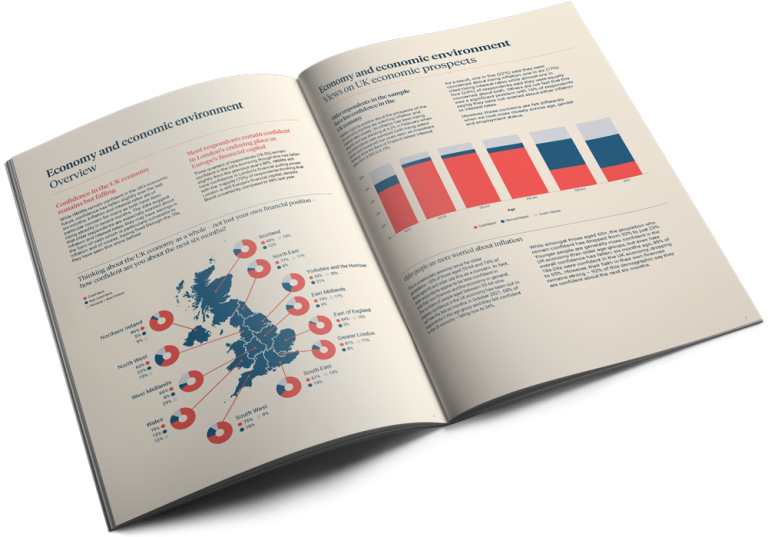
Economic confidence drops to 56%

Confidence in the UK economy has fallen from 66% to 56% over the past year. Just one in five (20%) HNWIs are now very confident, against 28% a year ago, while almost a quarter (23%) are unconfident, up from 19%.

However, the data show that confidence in the economy varies significantly by age. While three quarters (76%) of 25-34 year olds and 70% of 35-44 year olds are confident in the economy, that falls to just 32% of 55-64 year olds and only 15% of over 65s, most of whom (54%) are unconfident. Those HNWIs with the longest experience of the UK economy are the least sure of it.

10 editions on: Economic confidence has never regained its August 2024 high of 84%. The fall from 84% to 48% by January 2025 remains the single largest decline in five years of tracking.

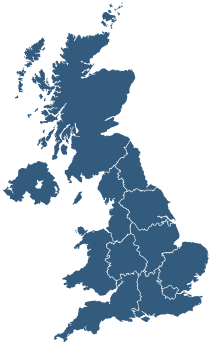
map of scotland
Scotland
arrow scotland
(6%)
map of north uk
North East
arrow north-east
(17%)
Yorkshire
arrow yorkshire
(4%)
North West
arrow north-west
(17%)
map of south east uk
East Midlands
arrow east-midlands
(1%)
East Of England
arrow east-of-england
(12%)
Greater London
arrow greater-london
(16%)
South East
arrow south-east
(5%)
map of south west uk
Wales
arrow wales
(10%)
West Midlands
arrow west-midlands
(13%)
South West
arrow south-west
(7%)
map of northern island
Northern Ireland
arrow northern-ireland
(9%)
map of UK

Tax and wealth policy under the new Government

Tax concern now defines HNWI sentiment

When asked how they feel about the range of tax and wealth policies Andy Burnham’s new Government has either proposed, or is likely to propose, HNWIs are concerned across the board. The potential 10% death tax on estates prompts the strongest response with almost a third (31%) saying they are very concerned, the highest of any policy we asked about.

Further changes to pensions are also a key concern – 29% are very worried about the potential for more reforms, with a further 40% ‘quite concerned’, and just 9% say they are not worried at all. On top of the 31% who say they are ‘very concerned’ about the introduction of a 10% death tax on all estates, 36% are also ‘quite concerned’. Two thirds are concerned about further IHT and estate planning changes (67%), removing the pension tax free lump sum (66%), changes to the ISA regime (66%), CGT raised to match Income Tax (64%), a land value tax (64%), and a new annual wealth tax (62%).

This unease is already starting to shape intentions, with HNWIs actively looking to restructure their wealth to move their assets and, in some cases, to consider leaving the UK.

“ Legislation and its potential impact on our clients’ personal finances will always remain a talking point. Their concerns are understandable; however, my view is that decisions should be based on confirmed policy rather than speculation.

A recent example involved a client I had recently started working with who withdrew all their available tax-free cash from their pension because they feared the entitlement would be restricted at the previous Autumn Budget. The anticipated change did not materialise and, for the time being, the client is now in a less favourable position. The withdrawn funds now form part of their estate for Inheritance Tax purposes and it has moved from a pension, where investment growth is tax-free, into a less tax-efficient arrangement.

By acting prematurely on fear and conjecture, individuals can leave themselves worse off. At Saltus, our approach is to assess whether an action is beneficial under the rules that apply today, while also modelling potential changes and preparing appropriate contingency plans. This allows clients to remain ready to respond without making irreversible decisions before the detail and timing of any new policy are known.”

Alex Pugh
Chartered Financial Planner, Partner, at Saltus

10 editions on: Five years ago the taxes now feared most – an annual wealth tax, a death tax and reform to pensions – were barely part of the conversation. That is certainly not the case today.

The tax policies HNWIs fear most under the new Government

Reset

% of HNWIs ‘very concerned’ or ‘concerned’

The tax burden and unfair taxes

Higher rate Income Tax seen as both the least fair tax and the biggest brake on growth

A growing number of HNWIs (43%) think they pay too much tax, up from 34% five years ago. Just over half (54%) say they pay the right amount, and 3% think they should pay more.

When asked which taxes they think are the most unfair, HNWIs point first to higher rates of Income Tax (20%), then IHT (13%), the basic rate of Income Tax (9%), CGT (9%), Council Tax (8%) and VAT (8%).

When it comes to complexity, the same taxes that are considered to be unfair are cited by respondents – IHT (30%), CGT (24%) and pension tax relief and allowances (20%) are seen as the most complicated parts of the system – and all three have seen significant policy change over the past three years.

In terms of the taxes they believe to be the greatest brake on growth, HNWIs cite the higher rates of Income Tax as having the biggest impact (15%) followed by the basic rate of Income Tax (12%), VAT (10%), Corporation Tax (10%) and Employer National Insurance (9%).

10 editions on: The share of respondents saying they pay too much tax has risen from 34% in 2021 to 43% today – a steady climb over five years – lower than the 49% peak recorded in the previous edition of this report, but with a clear upward trend.

The most unreasonably high tax

Reset

% of HNWIs who see each single tax as the most unreasonably high

Share of HNWIs who think they pay too much tax

Reset

The most complicated areas of the tax system

Reset

% of HNWIs who see each tax as one of the three most complex

London’s standing and tax complexity

Majority still back London but faith it will remain Europe’s financial capital is slipping

Most HNWIs still have confidence in London, with more than six in ten (62%) believing it will remain Europe’s financial capital over the next decade. However, that is down from 73% a year ago, and almost a quarter (24%) now think it will not remain the centre of Europe’s financial web.

Belief that London will remain Europe’s financial capital

Reset

10 editions on: Belief in London as a financial centre has softened from 68% in 2021 to 62% now – a slow erosion rather than a collapse, but consistent with the wider loss of confidence in the UK economy.

Personal finance

Overview

Confident about their own money, but tax and policy now outrank previous worries

In a period in which markets have been strong, HNWIs remain broadly confident about their own finances. However, the margin between those who are confident and those who are unconfident is narrowing and the nature of their concerns is changing, shifting decisively away from mortgages and interest rates and towards tax and government policy .

Confidence in personal finances stands at 84%, down slightly from 87% six months ago and 92% a year ago – but, overall, this 10th edition presents a broadly positive view.

Inflation (45%) and tax changes (40%) are still seen as the top two risks to wealth. AI is now used by 23% of HNWIs for financial guidance, more than two and a half times the level of six months ago (9%), and 22% trust it enough to act on it – though professional financial advice remains by far the leading and most trusted source (54%).

Gaps in estate planning persist, for example, fewer than half (47%) of HNWIs have a will – although the number with a will increases significantly with age.

10 editions on: Personal finance confidence is for now more robust than confidence in the economy, but at 84% it sits at its weakest since 2023.

Confidence and wealth protection

Confidence erodes to 84%, and wealth protection is patchy

Confidence in personal finances is strong at 84%, a similar level to the 87% recorded six months ago, with the proportion of respondents who are very confident down from 41% to 36%.

The data also show that confidence tracks both age and wealth. Among the under 35s, confidence stands at 91%, but it falls to 72% among the over 65s. If we track this measure against the value of assets held by respondents, confidence climbs with wealth: 77% of those with less than £500k are confident, rising to 94% of those worth £5m to £10m. Among that wealthiest group, more than half (53%) are very confident, against a quarter (26%) of those below £500k.

The survey asked respondents about the measures they have in place to protect their wealth. Fewer than half (47%) of HNWIs have a will, only 29% have made formal pension beneficiary nominations, just 26% have set up a trust, and only one in ten (10%) have put conditions on gifts or inheritances. Just 10% of married HNWIs have a pre (6%) or post (4%) nuptial agreement, although this rises sharply to 27% of those who say they made their money ‘through a divorce settlement’.

The number of respondents with a will climbs steeply with age: 34% of 25-34 year olds, 40% of 35-44 year olds, 50% of 45-54 year olds, 58% of 55-64 year olds and 83% of the over 65s have a formal will in place. Just 42% of HNW parents with children under 18 have a will in place, although for those with adult children it rises to 72%, in line with the finding that wealth protection measures rise with age.

Large numbers of HNWIs do not take advantage of mainstream reliefs available to them, with 41% not using their personal tax allowance in the past year, 33% not using their ISA allowance and 52% not using their pension tax relief.

“The statistic on the number of people without a will is not surprising. Typically, when I meet clients, they have either yet to write a will or have one in place that requires updating. There are many reasons why this may be the case. If I were to surmise, modern life is busy, with competing pressures and often little time for life administration. Unless you are experiencing ill health or have recently been through a bereavement, planning for events that may not happen for many years understandably sits low on the list of priorities.

As financial planners, it is our role to highlight the risks of not having a will. The alternative is the risk of a client’s estate being distributed under the rules of intestacy. There is no flexibility within these rules, and, in many cases, the outcome does not reflect the client’s wishes.

One recent conversation I had was with a client whose estate exceeds £1 million and who is still yet to write a will. She wants her estate to pass to her partner, to whom she is not married, and his children. If she does not act, she faces a different scenario. Her estate would pass to wider family members with whom she now has little contact, which is exactly what she wishes to avoid. The only way to prevent this outcome is by putting a valid will in place.”

Alex Pugh
Chartered Financial Planner, Partner, at Saltus

HNWIs’ confidence in their own finances HNWIs’ confidence in their own finances

Reset

Legal and financial protections HNWIs have in place

Reset

% of HNWIs with each protection in place

10 editions on: Estate protection is driven by age rather than being a universal blind spot: older HNWIs are well covered, while younger and mid-life HNWIs lag. Even so, the fact that 53% of HNWIs have no will is striking given the size of the estates involved – on average, respondents have a net worth of £4.2m.

Risks and worries

Inflation still leads list of risks for HNWIs

Inflation remains the biggest risk to wealth, as cited by 45% of respondents, though this is down from 51% six months ago. Tax changes sit second at 40%, and third is geopolitical risk, up from 28% to 32%. Other key identified risks to wealth are energy prices, up from 27% to 30% and interest rates, although the number that cite it as a risk has dropped slightly from 30% to 28%.

When asked about their single biggest worry, and not just risks to their wealth, a financial concern still topped the list for HNWIs – the economy going into recession (13%). Health follows (11%), then rising taxes on property or investment income (9%) and future tax rises under the current Government (9%).

10 editions on: In 2021 the top risks identified by respondents were COVID (31%) and inflation (28%), while the biggest worry was the economy and the stock market. Five years on, fears of recession have faded and inflation still leads (45%), but tax has become a permanent fixture near the top – with geopolitics and energy the sharpest recent movers.

Biggest risks to personal wealth, according to HNWIs

Reset

HNWIs’ biggest worries

Reset

% of HNWIs who list each as their single biggest worry

AI and financial advice

HNWIs’ use of AI for financial advice has more than doubled in six months

Almost half (48%) of HNWIs consult a professional adviser, and this is still the leading source of guidance by some distance, followed by financial media (26%), search engines (24%) and AI tools (23%), then friends or family (19%) and social media (15%).

However, the jump in AI use is hugely significant. Six months ago, less than one in ten (9%) said they used AI for financial advice; this figure has now more than doubled to 23%. AI has already overtaken friends and family (19%) as a source of guidance, and almost a quarter (22%) say they would trust AI enough to act on its advice, again just ahead of friends and family, though the professional adviser remains the most trusted source by far (54%).

10 editions on: Five years ago ‘robo advice’ existed but was nowhere near the mainstream. Today, the use of AI has gone from unmeasured to nearly a quarter of HNWIs in the space of two editions, the fastest rising behaviour the Index has recorded.

Sources HNWIs have used for financial decision making

Reset

“AI is becoming an increasingly common feature of client conversations. We are seeing more clients use AI tools to research pensions, investing, tax planning and estate planning strategies before seeking professional advice. In many cases, this is a positive development, as clients come to discussions better informed and with a clearer understanding of the questions they want to ask.

Advisers are also beginning to use AI in meaningful ways. It can help with research, data gathering, summarising complex information and reducing the time spent on administrative tasks. Used appropriately, this allows planners to spend more time understanding a client’s circumstances, exploring different planning options and helping them make informed decisions. In this respect, AI has the potential to improve both the efficiency and accessibility of financial advice.

However, many clients quickly discover the challenge of applying generic information to a highly personal financial situation. While AI can be very effective at explaining concepts or identifying potential planning opportunities, it often lacks the context needed to assess whether a particular course of action is appropriate for an individual or family. Financial planning decisions are rarely made in isolation, and factors such as family relationships, existing assets, future objectives and changing tax legislation can significantly influence the advice that is ultimately given.

This is particularly relevant for HNWIs, whose financial affairs are often more complex. Decisions around retirement planning, trust structures, intergenerational wealth transfers or succession planning frequently involve balancing multiple objectives across several family members. In these situations, technical knowledge is only one part of the process. Understanding priorities, managing trade-offs and interpreting information in the context of a client’s overall circumstances are equally important.

Some clients have also expressed surprise at how confident AI can appear. As the use of AI grows, helping individuals distinguish between information and personalised advice is likely to become increasingly important. This gap between information and interpretation is where the role of the adviser becomes most apparent.

AI will undoubtedly continue to improve and will become an increasingly valuable tool for both clients and advisers. However, our experience is that when decisions have significant financial or family implications, clients still place the greatest value on having a trusted adviser who understands their circumstances, can challenge assumptions and provide clarity on the issues that matter most to them.”

Kwasi Yeboah
Chartered Financial Planner, Partner, at Saltus

IHT dominates estate anxiety

While the number of HNWIs who think Inheritance Tax should be abolished altogether is still significant at 26% (it was 30% six months ago), the vast majority would like changes to the current rules. Most think the IHT threshold should be increased: 20% want it to start between £500k-£1m and 17% want £325k-£500k. HNWIs put the fair starting point at around £1.2m, more than three times the £325k level, which is frozen until 2031.

Frozen thresholds and increasing property values have steadily pulled more estates into the IHT net, and with unspent pensions due to come into scope from 2027, IHT now shapes planning well beyond the wealthiest estates. The latest data in this report show that a quarter (25%) of HNWIs are now considering strategies to protect their pension from IHT, 22% say they would use trusts or other vehicles, and 19% are concerned the planned rule change will affect how they pass on their pension. Just 11% say they are not concerned about the impacts of IHT on their pension.

10 editions on: IHT has moved from a peripheral concern to a central consideration in HNWIs’ planning. It is now viewed as both the most complicated tax to navigate and one of the most feared.

HNWIs’ opinions on Inheritance Tax thresholds

Reset

“Whilst the freezing of thresholds is expected to drag more individuals into higher rates of tax, the proposed rules to bring unused pensions into the estate from April 2027 has resulted in a significant increase in inquiries from HNWIs around reducing their future inheritance tax liability.

Where there are surplus funds that can be ring fenced for gifting, concluding whether this should be an outright gift or a gift via trust is a complex decision. In the case of gifting to adult children, there may be concerns around the stability of child’s relationship which brings into discussion the use of a trust. Whilst the trust can be beneficial in protecting family assets, it also increases administration and potential costs, which can dissuade individuals from using them, even when it is the right solution.

Parents are often reluctant to single out one child, even if there is a specific concern applying to their circumstances. They tend to opt for an equitable approach for all of their children. There are of course exceptions to this, when we are dealing with minors, trusts are a necessary structure. Vulnerable adults may also be better suited to gifts via trusts rather than outright gifts, ensuring there is support with making financial decisions throughout their life.

An interesting development in recent months has been the number of HNWIs querying the future tax liability on their estate, when previously they were unconcerned about inheritance tax. Those with no children, who historically had little concern to their estate’s future tax bill, are now showing greater interest in this area. These are typically individuals with large pension plans that are unlikely to be spent in full during their lifetimes. Some are also set to inherit large pensions from their parents with the double tax hit of inheritance tax on the capital followed by income tax on the pension income. They may have made peace with the idea that property and savings above the nil rate band will be subject to taxation, but the inclusion of the pension seems to be changing their sentiment.

Advisers face two challenges when advising on this area. In respect of the pensions, the legislation, whilst drafted, is not yet live. There is a risk that a decision made today could be incorrect if death were to occur before April 2027, or in the event there is a U-turn on it coming into effect (unlikely but not impossible). Thus, the timing and execution of the advice need to be considered. The second challenge is around changing legislation. This is not in itself a new challenge for advisers, as we are used to regularly adapting to the changing landscape, but as some decisions can be irreversible, flexibility needs to be built into any plan so that it can adjust for a future change in legislation.”

Alex Pugh
Chartered Financial Planner, Partner, at Saltus

Pensions and retirement funding

HNWIs expect to need £740k to retire comfortably

On average, HNWIs have a pension pot worth £608k but believe they will need considerably more – around £740k for a ‘comfortable’ retirement, increasing to £880k for a couple.

However, even that ‘ideal’ pot may fall short. Under the 4% rule, a pot of £740k would provide an income of £29,600 per year, which, even with the State Pension, comes to just over £42k – around £64,600 a year less than the £106,665 average income that respondents are currently living on.

This shortfall may explain why so many HNWIs are looking beyond their pensions, and specifically at property, to fund their retirement. Housing is expected to do much of the heavy lifting, with seven in ten (71%) planning to use housing wealth to fund at least some of their retirement. Respondents’ homes are worth just over £1m on average, and they expect the value built up in their homes to fund almost half (44%) of their retirement, while 3% expect their home to cover all of it, rising to 9% among those with homes worth £3m or more. Just under three in ten (29%) plan to use no housing wealth at all.

10 editions on: Pensions have shifted from a longer term planning issue to a live political concern: 70% of HNWIs now worry about further Government changes while 66% fear losing the tax free lump sum – an issue that barely featured in the Index’s early editions.

What HNWIs consider necessary for a ‘comfortable’ retirement

Reset

Money, anxiety and freedom

Money still means freedom for most HNWIs

Around a third (36%) of HNWIs agree their money makes them anxious, broadly flat over the past year. At the same time, 85% agree their money is a source of freedom. In the previous survey, 90% of respondents believed this to be true.

10 editions on: The sense that wealth brings freedom has strengthened over the past five years, rising from 76% in 2021 to 85% now, a product perhaps of remarkable market resilience.

Reset
Reset

The value of private education

HNWIs still believe in private education, but increasingly question whether it is worth the money

The majority (62%) of HNWIs still believe private education delivers better long term outcomes than state education, but that confidence has softened across the board. Belief in the value of the networks private schooling provide is down from 72% to 66%, while the view that private schools offer better teaching has dropped from 69% to 61%. Confidence in the non academic benefits of private education has also fallen, from 68% to 62%.

The shift is even more pronounced when it comes to university. Belief in the value of a degree has fallen from 68% down to 57%. While a clear majority of HNW parents still think university degrees offer good value, when asked if they would rather use £50k (the approximate average university debt) to fund their child’s degree or invest in their future, six in ten (59%) said they would rather invest the money, either in an ISA or towards a property purchase, than spend it on university fees. Among those earning £250k or more, that rises to 71%.

10 editions on: Attitudes to private schooling have been tracked since the fifth Saltus Wealth Index Report, published in January 2024. Five rounds of data point to a clear shift in sentiment: that the question is less about whether private education has value and more about whether that value still justifies the higher cost post the application of VAT.

Attitudes towards private education

Reset

“Private education remains an important consideration for many of the families we work with, but there has been a noticeable shift in how younger high-net-worth parents approach the decision. Even households that appear well placed to fund private education are looking more closely at the trade-offs involved, as rising fees prompt a greater focus on value and opportunity cost.

For some families, private education continues to be a clear priority. For others, it is increasingly being weighed against alternative ways of supporting their children in later life, whether that’s funding university education, helping them onto the property ladder or providing financial support as they establish careers and families of their own.

In our experience, the decision is rarely driven by cost alone. Parents are seeking reassurance that whichever route they choose aligns with both their family’s values and their broader financial objectives. As financial planners, our role is not to determine whether private education is the right choice, but to help clients understand the long-term implications of that decision and the trade-offs that may come with it.

For families who do choose private education, early planning is often key. Cashflow modelling helps clients understand how school fees may impact other financial goals over time and whether those costs can be accommodated without compromising their own long-term financial security. The earlier these conversations take place, the greater the flexibility available, allowing families to make informed decisions with confidence.”

Kwasi Yeboah
Chartered Financial Planner, Partner, at Saltus

Private school fees and VAT

VAT on school fees continues to reshape behaviour

The cost of private education keeps rising. According to the Independent Schools Council 2026 Census, the average cost of sending a child to private school ranges from £18,678 a year for day pupils to £44,940 for boarders – an average increase of 4.4% on last year, which was already up 6.7% on 2024/25. Wealth Index data paint a similar picture: parents say their annual school fees have risen from an average of £34k in 2024/25 to £38k in 2025/26 and £40k in 2026/27.

As the cost rises, HNW parents are continuing to adapt, and for some the sums no longer add up. Just three in ten (30%) affected parents say they haven’t had to make any changes. Among those who have made changes, 6% have moved their child from boarding to day attendance at the same school, 8% have moved their child to a cheaper private school and 8% have moved house to access a good state school. A further 8% have taken their child out of private education altogether and moved them into the state sector.

Even among those who have managed to keep their child in private education, the financial pressure is clear. Eight in ten (78%) have had to make sacrifices to do so, the most common being cutting holidays and big ticket spending (21%) as well as everyday spending (19%), followed by leaning on financial help from others (12%), taking a better paid or additional job (11%) and reducing pension contributions (10%).

10 editions on: The number of affected parents making sacrifices to deal with rising school fees has climbed from around 55% in August 2025 to 68% in January 2026 and 78% today, a sign that the policy is increasingly shaping the decisions families make.

Sacrifices made by HNW parents to keep their children in private school

Reset

% of HNWIs having made sacrifices in each area

Lifestyle

Overview

The pressures on HNWIs are now forcing choices about mobility and family, not only lifestyle

The number of HNWIs who are either thinking about leaving the UK, or are actively in the process of doing so, has increased from 26% six months ago to 30% today. While this means that the majority are not looking to leave, three in ten represents a significant minority – and a clear sign that the UK’s wealthiest are increasingly questioning whether they want to remain here.

Family support continues, but regular support to adult children has eased, with 19% of respondents claiming they do this. And four in ten (42%) are concerned about the current or future value of their primary residence.

Leaving the UK

More HNWIs are weighing up leaving the country, with tax policy high on the list of reasons why

One in 12 (8%) of HNWIs say they are currently looking at whether it makes sense to leave the UK permanently within the next 12 months, while a further 22% could consider it in future – up from 14% six months ago.

The people thinking hardest about leaving are the younger and the wealthier. One in seven (14%) of under 25s say they are actively considering leaving, while a further 40% are considering it more widely; this is compared with fewer than one in ten (8%) of the over 65s.

The wealthiest HNWIs – those with a net worth of at least £5m – are the most likely to be thinking about leaving the UK, with 15% saying they are actively considering leaving the UK permanently within the year and 29% considering it more widely.

The primary reasons for considering leaving are personal (35%), financial (31%), political (19%) and cultural (15%), although tax is prominent across all categories. Further to those already considering leaving the UK, 18% said they would consider changing their tax residency, or moving abroad, if Capital Gains Tax was equalised with Income Tax.

10 editions on: When this research first asked about leaving the UK in 2024, it was a fringe consideration. Now, that ‘considering’ group has grown to more than one in five and tax policy is an explicit trigger for moving money and, for some, residency.

Primary reasons for considering leaving the UK

Reset

We have seen an increase in HNWIs querying the viability of a move abroad, with a clear goal being to reduce future inheritance tax concerns. Many of the HNWIs considering it have a natural right of residence overseas, either due to family ties or place of birth. Others are looking at countries that reward HNWIs with residency status and a path to citizenship following investment in the country.

Whilst a path to citizenship is an important hurdle to overcome, the practicalities of moving abroad and cutting your ties with the UK are often more complex. Finding a location which has a favourable tax regime, offers access to good healthcare (an important service as we age) and an acceptable travel distance from family back in the UK, is not always an easy blend to achieve. The reality of missing out on time with family, particularly seeing grandchildren grow up, or moving away from parents who may still be dependent, is a tough emotional decision to make. Establishing new friends is also an important consideration, with a support network not immediately available in the event of an emergency. The dream of life overseas may feel very different as a couple than as widow.

Additionally, legal and tax advice is required to insure you have all the necessary arrangements in place for your new jurisdiction, as well as understanding the tax implications of leaving the UK and how to effectively achieve a clean release from the UK inheritance tax loop.

When putting all the above together, many HNWIs conclude a permanent move overseas is unpractical and therefore look to other ways to reduce their inheritance tax liability.

Henrietta Grimston
Chartered Financial Planner, Partner, at Saltus

Destination of choice for HNWIs permanently leaving the UK

Croatia 1%
Cyprus 2%
Denmark 1%
France 3%
Germany 1%
Greece 1%
Italy 2%
Malta 1%
Netherlands 1%
Poland 1%
Portugal 5%
Spain 14%
Multiple 1%
Undecided 9%
Europe
Brazil 1%
Canada 5%
USA 14%
Multiple 1%
Undecided 9%
North America
Australia 8%
China 2%
Hong Kong 1%
Japan 2%
Malaysia 1%
New Zealand 3%
Singapore 2%
Thailand 2%
UAE 10%
Multiple 1%
Undecided 9%
Rest of World
Multiple 1%
Undecided 9%
World map

Supporting family

HNWIs remain the family safety net, although increasingly they are feeling the pressure themselves

The number of HNWIs providing regular financial support to adult children has declined slightly to 19% (perhaps a product that there is less money to handout), while a quarter (26%) have given a one off lump sum in the past five years. However, while fewer are giving regular support, those who do are giving more: the average sum has risen to £6,449 from around £4,800.

That support mostly covers items such as holidays (35%), general living expenses (33%), a house deposit (24%), a car or transport (23%) and household bills (17%).

Support for the older family members is falling, however. The proportion of HNWIs providing regular financial support to parents has dropped from 26% to 16%, and from around 40% in early editions of this report. HNWIs are pulling back from subsidising their parents even as they keep funding their children.

10 editions on: The bank of mum and dad has been a constant since this research began. What is changing is the mix of this support, from one off payments to regular support covering everyday living costs, a sign of continuing pressure experienced by children and grandchildren.

HNWIs providing financial support to adult children

Reset

Reasons why HNWIs are providing this support

Reset

% of HNWIs having provided support in each area

Funding family support

Supporting family increasingly means dipping into wealth meant for later

Of those who are still providing financial help to family members, most support still comes from income and investments, with 32% funding it from excess income and 25% from investments. But a large share of respondents are making harder choices – 19% have restructured their finances, 16% have cut personal spending and 9% have sold property. Pensions are also taking a hit, with 11% saying they are taking money out of their pension, 11% have withdrawn a lump sum over their tax free entitlement and 7% have reduced their pension contributions.

“A common mistake we see is families leaving intergenerational planning too late. By the time parents or grandparents decide they want to provide significant financial support, many of the most tax-efficient options are no longer available to them.

When planning starts earlier, families can gradually build wealth in children's ISAs or make use of strategies such as redirecting inherited assets through a deed of variation, allowing wealth to pass to the next generation in a more tax-efficient way. However, where these conversations happen much later, the choices can become more limited.

I've started working with clients who are only a few years away from retirement when they decide they want to help their children. In some cases, their only option is to draw on pension tax-free cash. Sometimes this entitlement is no longer available because it has already been withdrawn, for example to clear a mortgage, leaving future withdrawals taxable. While many clients are happy to make that trade-off to support their family, it ultimately reduces the assets originally intended to fund their own retirement and may mean accepting a lower standard of living.

The greatest opportunities often come to those who plan early. By starting the conversation sooner, clients can support future generations through gradual, tax-efficient gifting strategies, rather than being forced into more reactive decisions that may place unnecessary strain on their own financial security.”

Alex Pugh
Chartered Financial Planner

How HNWIs are funding support for family members

Reset

% of HNWIs using each source of funding

10 editions on: More HNWIs are now funding family support from pensions and asset sales than in earlier editions – irreversible choices that could permanently risk their own financial security in retirement for their family’s needs today.

The family home

Concern about the value of the family home is widespread

Four in ten (42%) HNWIs are concerned about the current or future value of their primary residence, with 12% very concerned. This worry might be linked to the fact that a large number of HNWIs are relying on the value of their home to fund at least part of their retirement.

Concern is highest in Scotland (52%), Wales (47%) and Greater London (45%). HM Land Registry figures show London is the only English region where prices are falling, down 2.5% in the year to June 2026 against a UK average of 2.0% growth. In Scotland (+2.3%) and Wales (+1.8%) prices are still rising – so concern there might be being shaped by something other than falling values, including devolved measures such as Scotland’s second home surcharge or Welsh council tax premiums of up to 300%.

10 editions on: Property has shifted from an assumed store of wealth to a source of worry, reflecting both interest rate uncertainty and speculation about property and land value taxes under the new Government. A land value tax, which was not on the agenda when the Saltus Wealth Index survey began five years ago, concerns 64% of HNWIs today. That anxiety is particularly significant because so many HNWIs are relying on their property wealth to fund at least part of their retirement.

HNWIs concerned about the value of their primary residence

Reset

10 editions, 10 takeaways

The Saltus Wealth Index in review

What five years of high net worth sentiment tells us

  1. Faith in the UK has fallen: Confidence in the economy has dropped from 80% in August 2021 to 56% today.
  2. Faith in their own finances has not: Personal finance confidence has barely moved (91% to 84%), with strong performance in financial markets through this period maintaining this optimism.
  3. One Budget did the most damage: The steepest single move in five years was economic confidence falling from 84% to 48% after the first Labour Budget (August 2024 to January 2025).
  4. Tax came out of the shadows: The share of HNWIs saying they pay too much tax rose from 34% to a 49% peak, and tax changes as a risk to wealth climbed from barely registering to a permanent top two concern.
  5. What the Government does next is the new worry: Under the new Government, a majority of HNWIs are worried about every wealth policy covered, led by further pension changes (70%), a 10% death tax on estates (67%) and further Inheritance Tax changes (67%). These concerns were barely on the radar five years ago but are now central to how HNWIs think about their wealth and future.
  6. Leaving the UK has become a real consideration: This question was not included in the survey until 2024, but today one in 12 (8%) HNWIs are actively exploring it, and a further 22% could consider it in future.
  7. AI arrived from nowhere: From an unmeasured category to 23% of HNWIs using it for financial guidance, up from 9% in six months.
  8. School fee pressure keeps building: VAT on school fees has pushed 78% of affected parents into changes or sacrifices to keep their children in private education.
  9. Inheritance Tax became a lightning rod: IHT is now seen as the most complicated part of the tax system (30%) and sits among the most feared policies under the new Government.
  10. Some things do not change: The professional adviser is still the first and most trusted port of call, and HNWIs remain the family safety net – with the bank of mum and dad remaining a central part of how many HNW families support the next generation. Both are proof that beneath the turbulence, the fundamentals of managing wealth hold strong.

Five years on, while HNWIs’ confidence in their own finances has been relatively resilient, it has remained so in the context of strong performance in global financial markets. The confidence of this constituency in the UK economy, the tax system and the direction of government, however, has been in steady decline throughout this period.

Methodology

  • The research was conducted by Censuswide, among a sample of 2,001 UK respondents aged 18+ who have £250k+ investible assets. The data were collected between 04.08.2026 – 17.08.2026.
  • Censuswide is a member of the Market Research Society (MRS) and the British Polling Council (BPC), and a signatory of the Global Data Quality Pledge. They adhere to the MRS Code of Conduct and ESOMAR principles.
  • Some of the figures in this report have been rounded to the nearest whole number, so in some cases the total for a chart will be slightly above or below 100%.

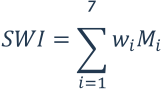
The formula which drives the Index is as follows:

Wealth index formula

This is the sum of the seven measures outlined below, Mi multiplied by their corresponding weights, wi.

  • Confidence in respondent’s own finances
  • Confidence about UK economy
  • Proportion of people who don't view interest rates, inflation, rising mortgage rates or high energy prices as one of their biggest risks to wealth
  • Confidence in London remaining as Europe’s financial capital
  • Anxiety about money
  • Belief in freedom that money can give
  • Belief that taxation is too heavy or too light

About Saltus

Saltus is a wealth management company that combines empathy and intellect in equal measure. We help our clients achieve their goals in life through expert financial planning as well as providing sharp focused investment management.

We started life as an investment management firm in 2004, yet over the years we saw that providing high quality investment management is just one of the ways we can help people achieve their aspirations.

Saltus Financial Planning was launched in 2015, with the aim of being an industry leader in providing financial advice. Saltus now employs over 500 people, and we have the privilege of looking after over £11bn for our clients.

Meet the experts

Saltus Financial Planning Ltd is authorised and regulated by the Financial Conduct Authority. Information is correct to the best of our understanding as at the date of publication. Nothing within this content is intended as, or can be relied upon, as financial advice. Capital is at risk. You may get back less than you invested. Past performance is not a guide to future performance. Tax rules may change and the value of tax reliefs depends on your individual circumstances. The Financial Conduct Authority (FCA) does not regulate tax, trust or estate planning.

Click here to download a PDF of the September 2026 report

Saltus Wealth Index September 2026 thumbnail

More reports...

Saltus Wealth Index Report - February 2026

Wealth Index Report

February 2026

Saltus Wealth Index Report - September 2025

Wealth Index Report

September 2025

About Saltus?

Find out more about our award-winning wealth management services…

Winner

Wealth Management Company of the Year (£10bn+ AUM)

Winner

Best Financial Advisers to Work For

Winner

Best Wealth Manager

Winner

Investment Performance: Defensive (Balanced) Portfolios

Winner

Wealth Management Company of the Year (£10bn+ AUM)

Winner

Best Financial Advisers to Work For

Winner

Best Wealth Manager

Winner

Investment Performance: Defensive (Balanced) Portfolios

£12.1bn+

assets under advice

21

years working with clients

500+

employees

32

awards

97%

client retention rate

£12.1bn+

assets under advice

21

years working with clients

500+

employees

32

awards

97%

client retention rate

Thank you for getting in touch

We've received your enquiry and one of our experts will be in touch with you within 1 working day.

To help us improve, we'd be grateful if you could let us know how you heard about Saltus.

How did you first hear about Saltus?
Please select one option.

Your response is optional and helps us improve.