Fraud Blocker Financial planning for early retirement | Saltus

Financial planning for early retirement

11 August 2026

Share this article:

Contents

    Key takeaways

    • Early retirement requires careful planning to ensure your wealth lasts throughout a longer retirement.
    • Cashflow modelling can help test whether your retirement plans are sustainable under different scenarios.
    • Most early retirees need to rely on assets outside their pension before reaching pension access age.
    • A diversified investment strategy and careful withdrawal planning can help manage long term risks.
    • Using pensions, ISAs and other tax wrappers efficiently can improve retirement outcomes.
    • Professional advice can help navigate complex decisions around pensions, tax and retirement income.
    Read more...

    Is retiring early your goal? For many, retiring early is the dream. But let’s not avoid the reality, financial planning for early retirement in the UK can be complex.

    The core challenge is the length of time your capital must sustain withdrawals. Retiring at 50 rather than 65, for example, can add 15 years to the drawdown phase. Not to mention, the early years of retirement are rarely inactive. Assuming your health allows, these are often the years you want to do the things that full-time work previously made difficult. As a result, spending can be higher at exactly the point earned income stops.

    The key question, therefore, is not whether early retirement is achievable, but whether it is sustainable. Answering this requires detailed analysis of cashflow, tax positioning, pension access constraints and withdrawal sequencing.

    What does early retirement mean?

    Early retirement refers to stopping full-time employment before the normal minimum pension access age. In the UK, this is currently 55, rising to 57 from April 2028.[1]

    If you plan to retire early, you will likely need to fund part of your retirement from non-pension assets. This creates a two-phase structure:


    How to consolidate your pensions…

    A practical guide to simplifying your pensions and avoiding costly mistakes...

    • A pre-pension phase, funded from liquid and taxable assets
    • A post-pension phase, where tax-advantaged pension capital becomes available

    The interaction between these phases is central to effective planning.

    How to plan for early retirement

    Retiring early is not simply about earning more. Understanding how to plan for early retirement requires a clear strategy for managing wealth, spending and investment risk over time. While individual circumstances will vary, most effective strategies are built on a small number of core principles.

    1. Identifying how much you will need

    The first step is defining your ‘target number’. This is the level of capital required to support your desired lifestyle throughout retirement. Traditional rules of thumb, such as withdrawing 4% per year or multiplying annual expenditure by 25, can provide a rough starting point.[2] However, they can be overly simplistic and should not be relied upon in isolation, particularly for longer retirement horizons.

    A more robust approach is to model your expected income, expenditure and asset values over time. This should incorporate realistic assumptions for inflation, investment returns and taxation. Structured cashflow modelling enables you to understand not only whether your plan is viable, but also how resilient it is under different economic conditions. A financial adviser can add significant value at this stage.

    1. Investment strategy

    Investment strategy is another important component of early retirement finance. Early retirement extends the period over which your portfolio must sustain withdrawals, which increases exposure to market volatility. A well-diversified portfolio that balances long term growth with sufficient liquidity to fund near term spending is important.

    Attention should be paid to sequence of returns risk. Poor market performance in the early years of retirement, combined with ongoing withdrawals, can significantly reduce the longevity of a portfolio. We go into more detail about this in our article on active vs passive investing.

    1. Tax efficiency

    Tax efficiency also plays an important role in early retirement planning. The objective is to minimise tax across the full lifecycle of your wealth, including income tax, capital gains tax and inheritance tax. This typically involves using a combination of tax wrappers and structuring withdrawals carefully to optimise outcomes over time.

    Do you need help with your retirement planning?

    Our specialists can help you prepare for retirement and provide ongoing advice once retirement has arrived. Get in touch to discuss how we can help you.

    Request a call back

    driving illustration

    Can I afford to take early retirement?

    This is often the central question and answering it requires a clear understanding of how your assets will perform once withdrawals begin.

    Early retirement shortens the accumulation phase and brings forward the point at which you begin drawing on your portfolio. This can increase the risk of depleting your capital prematurely if withdrawals are not carefully managed relative to investment returns.

    Cashflow modelling can provide a more sophisticated framework for assessing affordability. Unlike static projections, cashflow modelling allows for a more dynamic analysis, incorporating different market scenarios and probabilities. This enables a more realistic assessment of how your plan may perform in practice depending on the method used.

    It can help you evaluate:

    • The sustainability of different withdrawal rates
    • The impact of market downturns early in retirement
    • The effect of changes in spending patterns
    • The viability of intergenerational gifting or legacy planning

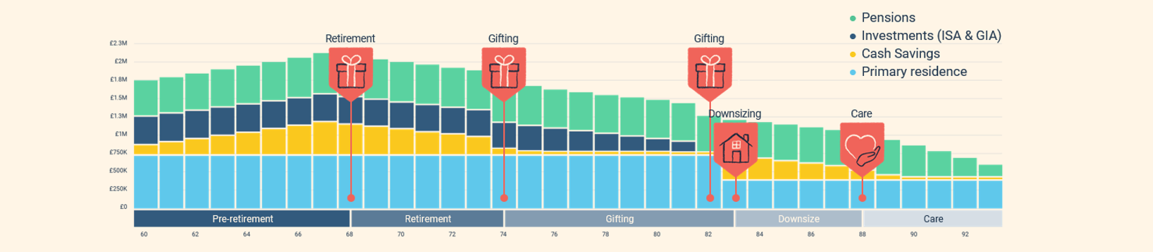
    A simple example of what this can look like is below:

    How to fund early retirement before pension access

    One of the biggest challenges when considering how to fund early retirement is bridging the gap between stopping work and accessing pension funds. Since pensions access is, in most cases, restricted until at least age 55 (rising to 57 in 2028), many individuals rely on alternative sources of capital during this period.

    These might include:

    • ISAs
    • Cash reserves
    • General investment accounts
    • Offshore bonds
    • Venture Capital Trusts (VCTs)
    • Business sale proceeds or deferred compensation

    A key consideration is drawdown sequencing. In many cases, it is efficient to utilise taxable accounts first, allowing pension assets to benefit from continued tax-deferred growth. However, this must be balanced against future tax exposure and overall portfolio allocation.

    The role of ISAs, pensions and tax wrappers

    Tax wrappers should be viewed as components of a single system rather than standalone vehicles. Each has a defined role within an early retirement strategy.

    WrapperTax treatment
    PensionsTax relief on entry, tax-deferred growth, taxable withdrawals
    ISAsTax-free growth and withdrawals
    General investment accountsSubject to capital gains tax and dividend/income tax
    Offshore bondsTax-deferred growth; up to 5% of the original investment can typically be withdrawn each year on a cumulative basis without an immediate tax charge

    Let’s look at an example to see how different tax wrappers can work together to create a sustainable retirement income. The figures are for illustration only and do not take account of investment returns, inflation, charges, tax, changes in legislation, expenditure or longevity. Actual outcomes will depend on individual circumstances.

    Consider Charlotte, who retires at age 50 with:

    • £750,000 pension
    • £350,000 in ISAs
    • £150,000 in an offshore bond
    • £100,000 in a general investment account (GIA)

    She wants to withdraw around £50,000 a year while maintaining flexibility and managing her tax liability.

    During the first few years of retirement, before she can access her pension, Charlotte funds her lifestyle using £25,000 from her ISA, £7,500 from her offshore bond and £17,500 from her GIA each year. This provides her target income without the need to draw on pension assets.

    Once she can access her pension, she adjusts her withdrawals to make efficient use of the available tax wrappers. For example, she could withdraw £20,000 from her pension, £20,000 from her ISA and £10,000 from her offshore bond. These are gross withdrawals, so the amount available to spend after tax will depend on her individual circumstances, as pension withdrawals may be subject to income tax and offshore bond withdrawals may create a future tax liability.

    When Charlotte reaches State Pension age, the State Pension may cover part of her withdrawal needs, reducing the amount she needs from her investments. Reviewing her withdrawal strategy regularly can help make efficient use of available tax allowances while adapting to changing circumstances.

    Retirement spending patterns

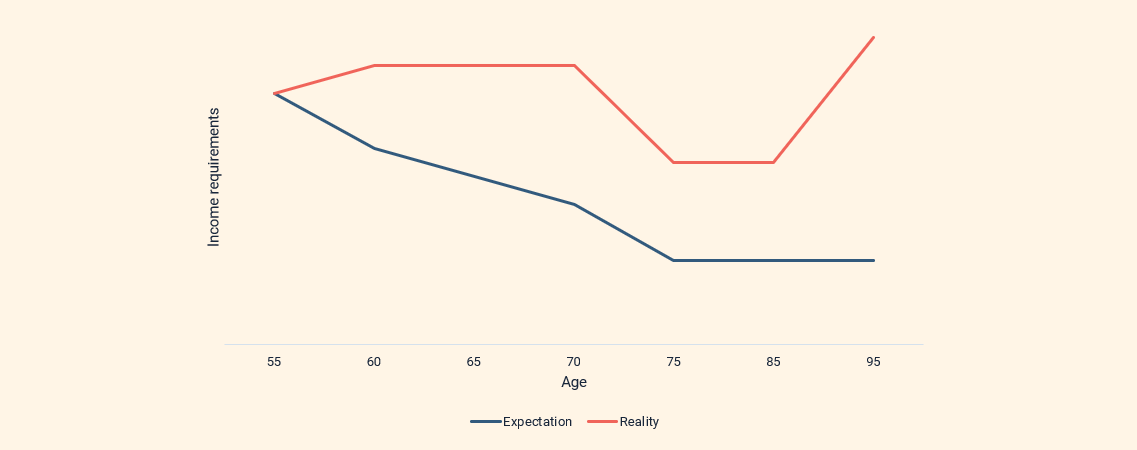
    Understanding spending patterns in retirement is important because expenditure is rarely consistent throughout later life. The “retirement smile” concept provides a useful framework. Spending is typically higher in the early years, declines in mid-retirement, and may increase later due to healthcare costs.

    For early retirees, this pattern is often more extended. The initial high spending phase can last longer, particularly where individuals remain active or pursue new interests.

    Early retirement and financial independence

    The concept of financial independence, often associated with the FIRE movement (Financial Independence, Retire Early), has gained popularity globally.[3] At its core is the idea that your investments generate sufficient income to cover your living expenses indefinitely.

    For high net worth individuals, this is typically less about aggressive cost cutting and more about structuring wealth to provide flexibility. In practice, this means having sufficient accessible assets, alongside longer term investments and other tax wrappers, to support a chosen level of expenditure without reliance on employment income. Early retirement may still include part-time work or other income streams, but these are optional rather than necessary.

    When to seek financial advice

    The complexity of early retirement planning means professional advice is often beneficial, particularly when multiple variables interact. This is especially relevant where decisions around pension access, tax structuring and withdrawal sequencing have long term and sometimes irreversible impacts. With the right level of forward planning and structured analysis, early retirement can be both achievable and sustainable.

    FAQ

    There is no fixed requirement. A common starting point is 25 times annual expenditure or the 4% rule, but detailed modelling provides a more accurate and reliable assessment.

    Typically through ISAs, general investment accounts and cash reserves. These provide liquidity during the pre-pension phase.

    Currently 55, rising to 57 from April 2028.

    In most cases, you cannot access your pension before the normal minimum pension age. Limited exceptions include serious ill health and certain protected pension ages.

    Be wary of schemes offering early access outside these exceptions, as unauthorised withdrawals can result in tax charges of up to 55%.

    A pattern of retirement spending where expenditure is typically higher in the early years, as individuals remain active and pursue travel or other goals, before declining in mid-retirement and potentially increasing again later in life due to factors such as healthcare or support needs.

    A forward-looking analysis tool that projects income, expenditure and asset values under multiple scenarios to assess sustainability. It typically accounts for external factors such as inflation and different market conditions.

    Do you need help with your retirement planning?

    Our specialists can help you prepare for retirement and provide ongoing advice once retirement has arrived. Get in touch to discuss how we can help you.

    Request a call back

    driving illustration

    Article sources

    Editorial policy

    All authors have considerable industry expertise and specific knowledge on any given topic. All pieces are reviewed by an additional qualified financial specialist to ensure objectivity and accuracy to the best of our ability. All reviewer’s qualifications are from leading industry bodies. Where possible we use primary sources to support our work. These can include white papers, government sources and data, original reports and interviews or articles from other industry experts. We also reference research from other reputable financial planning and investment management firms where appropriate.

    Saltus Financial Planning Ltd is authorised and regulated by the Financial Conduct Authority. Information is correct to the best of our understanding as at the date of publication. Nothing within this content is intended as, or can be relied upon, as financial advice. Capital is at risk. You may get back less than you invested. Past performance is not a guide to future performance. Tax rules may change and the value of tax reliefs depends on your individual circumstances. The Financial Conduct Authority (FCA) does not regulate tax, trust or estate planning.

    About Saltus?

    Find out more about our award-winning wealth management services…

    Winner

    Wealth Management Company of the Year (£10bn+ AUM)

    Winner

    Best Financial Advisers to Work For

    Winner

    Best Wealth Manager

    Winner

    Investment Performance: Defensive (Balanced) Portfolios

    Winner

    Wealth Management Company of the Year (£10bn+ AUM)

    Winner

    Best Financial Advisers to Work For

    Winner

    Best Wealth Manager

    Winner

    Investment Performance: Defensive (Balanced) Portfolios

    £11.2bn+

    assets under advice

    20

    years working with clients

    500+

    employees

    32

    financial awards

    97%

    client retention rate

    £11.2bn+

    assets under advice

    20

    years working with clients

    500+

    employees

    32

    financial awards

    97%

    client retention rate