
Welcome to the Saltus Wealth Index Report. This our tenth edition. It’s a milestone more than a landmark. What we see is a continuation of the narrative of the past few years. Our respondents are finding the economic and political weather increasingly uncongenial, and their prognosis is increasingly gloomy.
Our intention has been to plot the ambitions, hopes and fears of the UK’s High Net Worth Individuals (HNWIs). In a world which is increasingly presented by politicians to voters as “have anything you want and somebody else will pay for it”, these are the people who are doing the paying. Their opinions matter, however, because not only do they stump up the tax that drives Government’s spending programmes, but they also produce the wealth through their hard work and creativity that will underpin the prosperity of future generations.
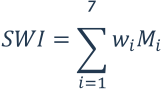
We have worked with Dr Michael Peacey from the University of Bristol to present the views of this audience in a single number: the Saltus Wealth Index. It has drifted down in the latest survey to 60.3 (from 61.3 six months ago). It is not the lowest it has been. That distinction goes to Liz Truss and her memorable budget, but the trend is clear. However, the brief moment of optimism that followed the election of Keir Starmer has evaporated.
So, we have (another) new Prime Minister, but the story is the same.
Increasing numbers of our respondents believe they pay too much tax. Moreover, they are fearful of what a Burnham budget will bring. They see growing problems with Britain’s schools and universities, which they care greatly about. They are supporting not only their children but, in many cases, also their parents, often at the expense of their own future, with many reducing pension contributions to do so.
It is no surprise that a fifth of HNWIs are now considering leaving the UK with 8% actually in the phase of active planning for this.
The bright spot is that they have retained some optimism relating to their own finances. This will in part be down to their careful handling of their money, but it is likely also to be a product of the performance of markets which have been pretty resilient so far, despite enduring quite a buffeting. If this indicator is indeed driven by market performance, then perhaps it too is a fragile one.
In effect, over the ten editions of the Saltus Wealth Index Report, the story has generally been more of the same in increasing quantities. Except in one respect.
That is technology. For the first time, we see AI having an impact on the way people manage their money. While a financial adviser is still seen by some distance as the most valuable and trusted source of assistance, increasingly HNWIs are turning to AI to drive their financial decision making, with these tools being used by more than 20% of our sample. We expect this to continue and grow, and it will be a theme of further reports.
As always, my thanks go to our partners at Censuswide, who deliver the survey, and Dr Peacey, who helps us interpret this valuable data. I hope you enjoy the report.