
Fraud Blocker Asset allocation update November 2025 : How we're thinking about markets... | Saltus

Asset allocation update

Share this article:

Asset allocation update How we're thinking about markets...

5 February 2026

Share this article:
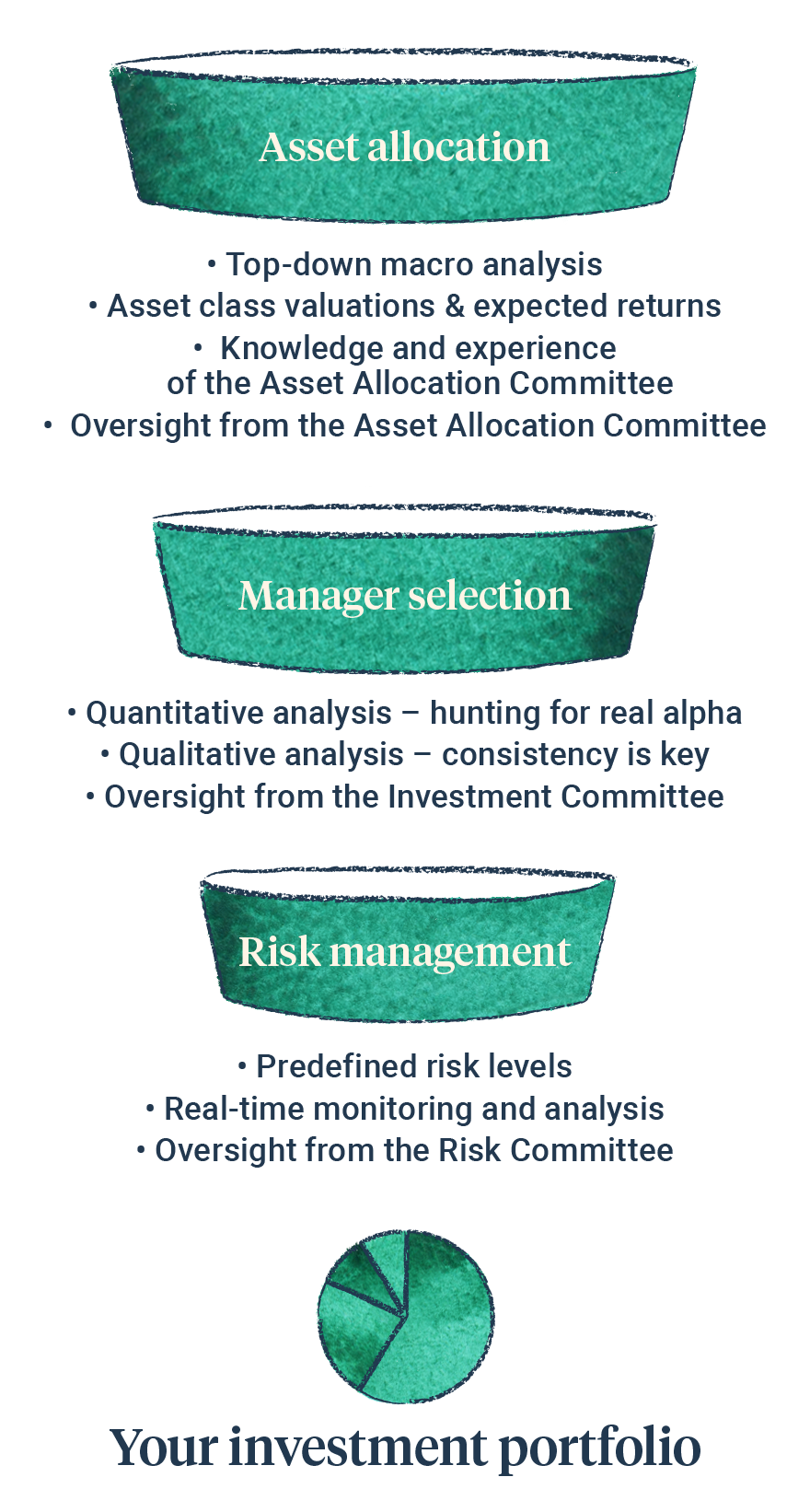
Investment Process funnel diagram

Investment conditions

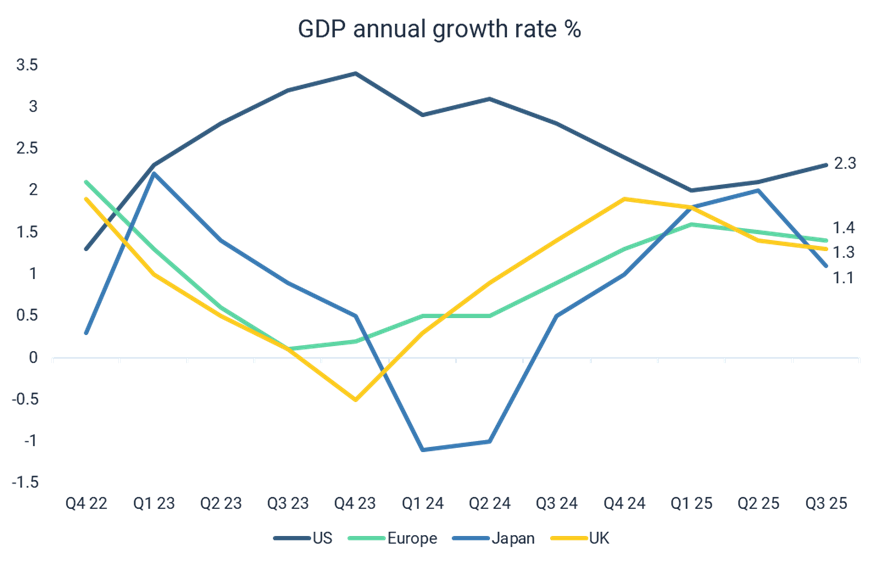
Global growth proved more resilient in 2025 than many expected. While real GDP growth across most developed markets fell slightly short of long term targets, the outcome was still respectable given the backdrop of a deteriorating geopolitical landscape, rising trade barriers, and a series of policy shocks that made forecasting unusually difficult.

The US was the outlier in delivering growth slightly ahead of target and trending upwards. Much of this was driven by a surge in capital investment, particularly in data centres and AI‑related infrastructure, which has become one of the defining economic themes of this cycle.

Despite the resilience we’ve seen, looking forward, we are wary that the impact of changing global order has yet to flow through to real economies, reflected in consensus forecasts now pointing to a moderation in real GDP growth during 2026.
Source: Saltus, Trading Economics

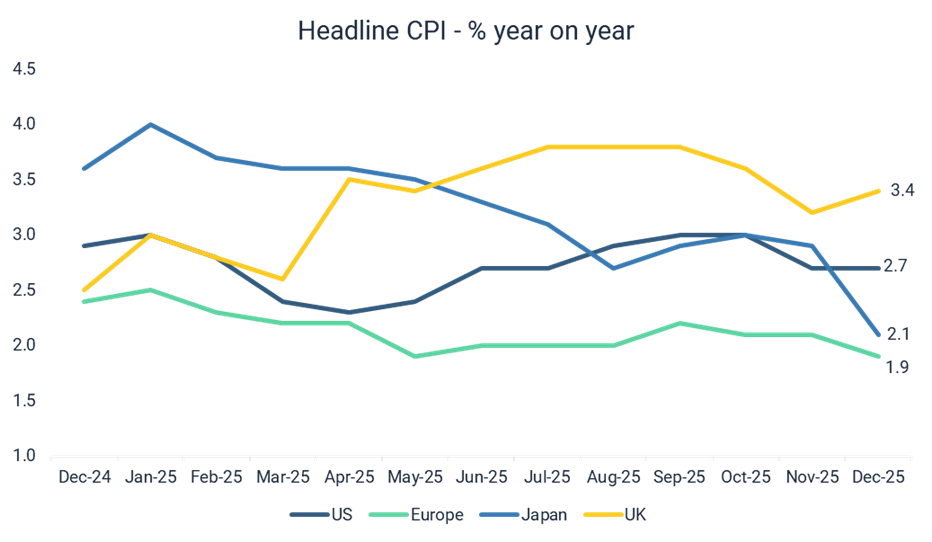
Inflation is steadily weakening across major economies, albeit at a higher level than central banks would ideally like. In the US, the December print came in at 2.7%, and markets expect it to fall below target over the next year, despite the strong economy Trump is projecting ahead of the November midterms.

Europe and Japan are also seeing continued disinflation, reinforcing the view that global price pressures are normalising. In the UK however, inflation remains sticky above target at 3.4%, highlighting the difficulty the Bank of England is having in squeezing inflation out the system.

Source: Saltus, Trading Economics

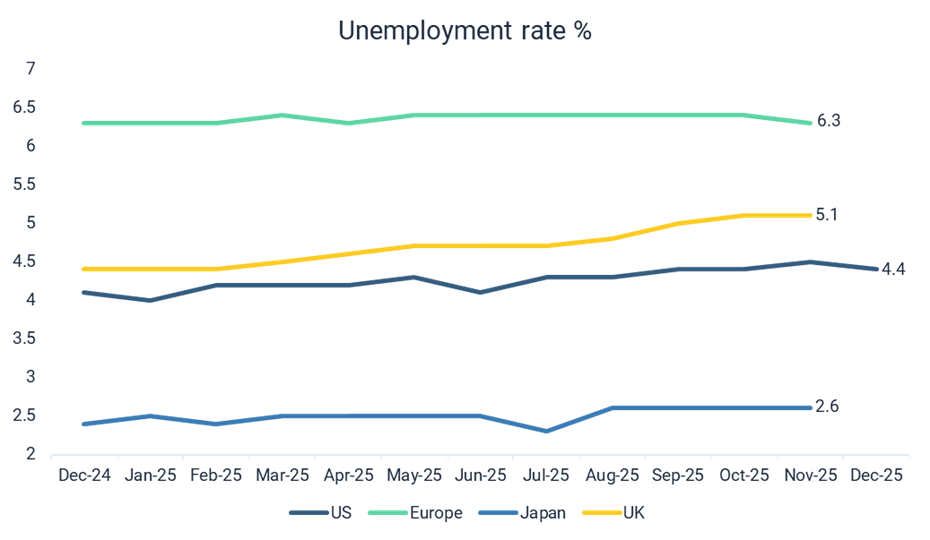
Labour markets remain generally robust but are showing signs of cooling. In the UK, unemployment has been edging higher and vacancy numbers are declining, particularly in entry‑level roles. The US job market is softening too, though from a position of relative strength. Europe displays more mixed conditions, with some regions showing surprising strength but an overall picture of gradual weakening. Japan remains the outlier, with a tight labour market and only modest signs of easing.

Source: Saltus, Trading Economics

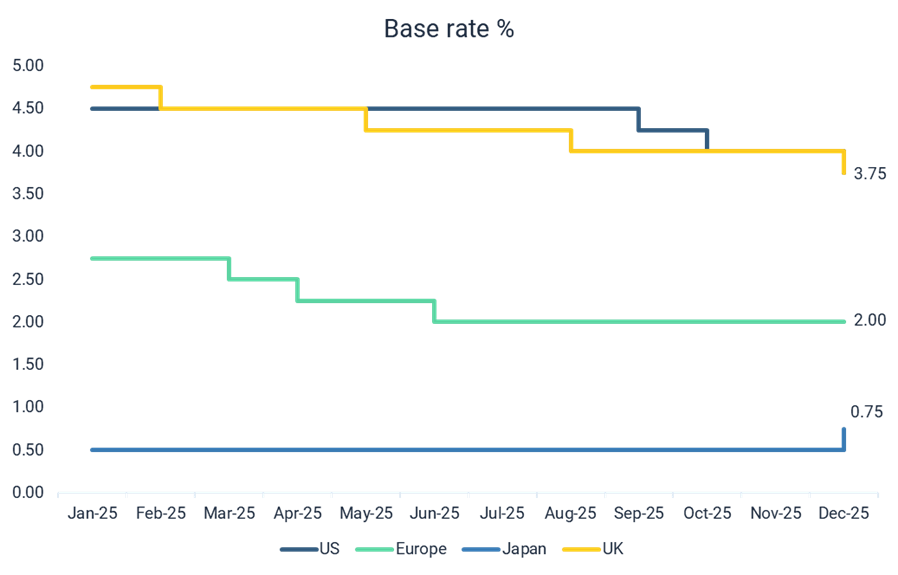
Despite there being limited signs of major economies slowing (aside from China) or heading towards recession, both the Federal Reserve and the Bank of England delivered additional rate cuts in December.[1] [2] These decisions were finely balanced, but the rationale was to support momentum while inflation is drifting back towards target and growth indicators are softening.

While one or two further cuts remain possible, we believe the global easing cycle largely peaked in 2025. The year ahead will be a pivotal one for the world’s largest central bank, as markets assess what Kevin Warsh’s recent nomination may signal for the direction of future monetary policy.

Source: Saltus, Trading Economics

Market Themes

Divergence in the Stars: The Magnificent Seven Break Formation

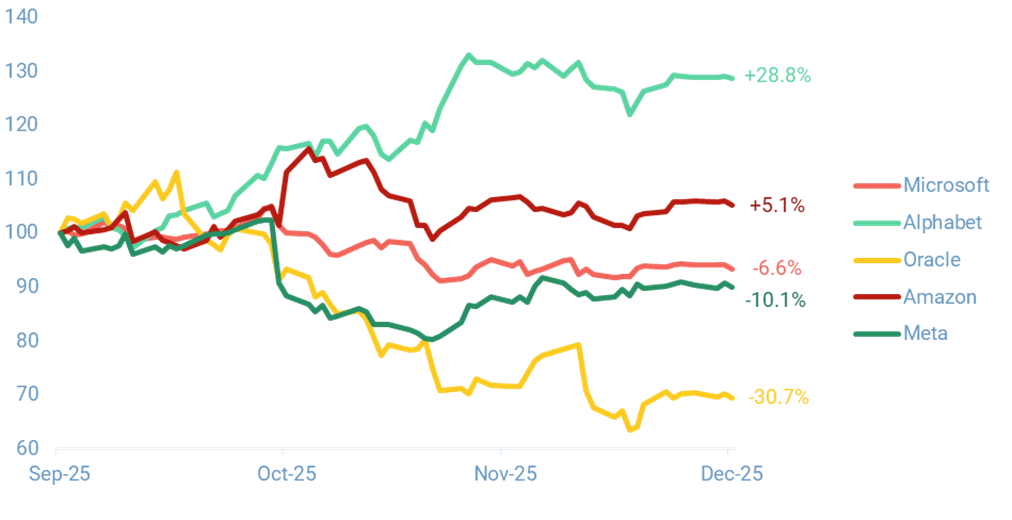
Over the past year, the so‑called “Magnificent Seven” have continued to dominate headlines and, collectively, global equity returns.[3] Yet while these US technology giants are often spoken about as a single group, their share price performance has become increasingly uneven.

AI has been central to this change. What began as an exciting growth narrative has evolved into a capital‑intensive investment cycle. Developing, training and running large AI models requires significant spending on data centres, specialist chips and energy infrastructure. These costs are real, rising and, in many cases, front‑loaded, while the financial benefits are expected to emerge only gradually.

As a result, balance sheet strength is once again playing a critical role in shaping investor outcomes. Technology leader Alphabet (parent company of Google), is funding AI investment comfortably from robust cash flows, preserving flexibility and financial resilience.

Others, having already depleted much of their surplus cash in recent years, are increasingly reliant on external financing to maintain the pace of spending which the market is looking unfavourably on. Meta came under scrutiny in December for this reason, as did Oracle, whose shares fell sharply after the company announced its plans to play catch up with the hyperscalers, funded through significant debt financing.

Markets are responding by becoming more selective. Rather than treating AI exposure as a catch‑all positive, investors are differentiating between those companies most likely to translate technological leadership into sustainable profits. It seems markets are no longer looking favourably on companies burning endless amounts of cash on AI.

Source: Saltus, Bloomberg.

A New Age of Alliances

Another defining theme of the past year has been the reshaping of global economic alliances. As traditional trade relationships come under strain, countries are beginning to look beyond established partners and towards more flexible, pragmatic arrangements. The improvement in relations between Canada and China is testament to this.

During his speech at the World Economic Forum in Davos, Prime Minister and former Governor of the Bank of England, Mark Carney, outlined a clear vision for this evolving global order. He argued that the US‑centred trade system that has dominated global commerce for decades is becoming less dependable, and that mid‑sized economies must respond by building broader trade relationships.[4] The aim, he suggested, is not to abandon globalisation, but to reduce over‑reliance on any single partner and create greater resilience to political and economic shocks.

This philosophy quickly translated into policy. In early January, Carney visited President Xi in China, the first Canadian Prime Minister to do so since 2017.Canada lowered tariffs on a limited quota of Chinese electric vehicles to just over 6%, a marked contrast to the 100% tariff enforced on them by the US. In return, China significantly reduced tariffs on Canadian canola and other agricultural exports.

The UK appears to be moving in a similar direction. At the end of January, Prime Minister Keir Starmer travelled to Beijing to meet President Xi, the first step toward warming a relationship that has been strained for several years. Although specific policy commitments remain unclear, the visit reinforces the broader trend identified by Mark Carney. Countries are increasingly looking to diversify their trade ties rather than depend heavily on a single partner.

For investors, the reshaping of global alliances strengthens the case for global diversification in portfolios, providing protection as old rule books are rewritten.

Views by asset class

Equities

At a broad level, the committee remains comfortable with the overall equity exposure in portfolios and with the balance of regional allocations. The refinements agreed in the January committee meeting focus less on how much equity we hold and more on how the exposure is expressed within each region.

We maintain an underweight position to the US and our portfolios are deliberately less concentrated in the large US technology names. Instead, we see more compelling long term opportunities in markets such as Japan, emerging markets and frontier markets, where economic reforms, demographic shifts and improving corporate governance offer a more attractive long term set of return drivers.

In Japan, we held an equal blend of small and large cap companies, to capture the sustained economic growth in the region. We would acknowledge that the tilt towards small-cap hasn’t worked in our favour as of late – large-cap indices outperformed in the period immediately after the October election, and the yen has continued to weaken which tends to support the earnings of larger exporters more than domestically focused companies at the margins.

As a result, and given yet another forthcoming snap election, uncertainty around future budget priorities and aggressively rising Japanese bond yields, which typically disadvantage small caps to a greater extent, the committee has decided to alter the blend in favour of our large cap Japanese manager. This change better positions the portfolio to benefit from foreign investor flows, which typically enter larger indices first.

Within emerging markets, we are initiating a 2% position in Indian equities. Although India has lagged other parts of Asia recently, it remains one of the world’s fastest‑growing economies and continues to benefit from favourable demographics and a supportive fiscal and monetary environment. Introducing a dedicated India position also adds diversification to our existing emerging market exposure and lowers the correlation to world equity markets, which should add resilience to the overall portfolio.

Further, the UK allocation has been an ongoing area of debate. We are keeping the overall weight unchanged, but are shifting some of the small‑cap allocation into an all‑cap strategy. This allows us to capture what we see as a broad valuation opportunity across UK equities, while reducing the more specific exposure to smaller, growth‑tilted companies that have been particularly sensitive to a relatively weak domestic consumer.

Given the absence of both domestic and foreign investor flow, with UK equities having their fourth negative net flow year, we are reminded that cheap starting valuations are not enough to kick start strong investor returns. However, we note that larger caps had a very strong 2025 on an absolute and relative basis and our manager performed well in this space. We acknowledge that the global exposure of companies in the FTSE 100 is well placed to benefit from an acceleration in global growth.

Fixed Income

Given the uncertain outlook for both inflation and interest rates, the committee continues to maintain a low level of government bond exposure. In our view, if equities sell off, government bonds are unlikely to provide the level of protection they have offered in past cycles, making them less effective protection in portfolios than other asset classes.

Within corporate credit, we are increasing exposure to global investment-grade and high-yield bonds. In investment-grade, we see an opportunity to benefit from high-quality companies offering attractive yields. In high-yield, the team believes the asset class offers compelling income, supported by a still‑benign default and bankruptcy environment with resilient corporate fundamentals.

Alternatives and Currency

The alternatives allocation, particularly our exposure to commodities and precious metals, was the most actively debated area of the portfolio. We have been managing the copper position dynamically since establishing it in mid-2022, subsequently increasing the weighting in September 2025. While copper initially moved in line with the broader precious‑metals rally, it has recently experienced a sharp acceleration. Given the speed and scale of the move, the committee has decided to exit the position. We still believe in the long term structural case for copper and will continue to monitor the price in case an attractive opportunity arises.

Gold is another position we have been keeping a critical eye on. Bullion has continued its trend upwards, surpassing $5,500/oz for the first time in January. We still view gold as a strategic diversifier, offering protection against currency debasement and elevated geopolitical risk, but are mindful of the level prices have reached. We are maintaining our overall exposure to the metal but adjusting the balance between bullion and miners across risk bands, with a preference for bullion over miners in lower risk bands, and vice versa.

Finally, the committee agreed to increase exposure to the Japanese yen in lower risk bands given its appeal as a potential tail‑risk hedge should markets experience a broader correction.

Summary of positioning

Below is a summary of our views for each asset class, from strongly negative (- -) to strongly positive (+ +).

Asset Class

Asset class -- - Neutral + ++
Equities X
Government bonds X
Corporate bonds X
Alternatives X
Cash X

Asset Class Breakdown

-- - Neutral + ++
Equities USA X
UK X
Europe X
Japan X
Asia ex-Japan X
Emerging markets X
Bonds US Government X
Non-US Government X
Inflation-Linked Government X
Investment Grade Corporate X
High Yield Corporate X
Emerging Market Debt X
Alternatives Commodities X
Gold & Gold Miners X
Property X
Global Macro X
Equity Long/Short X
Absolute Return X
Infrastructure X
Currency Sterling X
US Dollar X
Euro X
Japanese Yen X
Emerging Markets X

Fund in focus: Konwave Gold Equity Fund

Summary

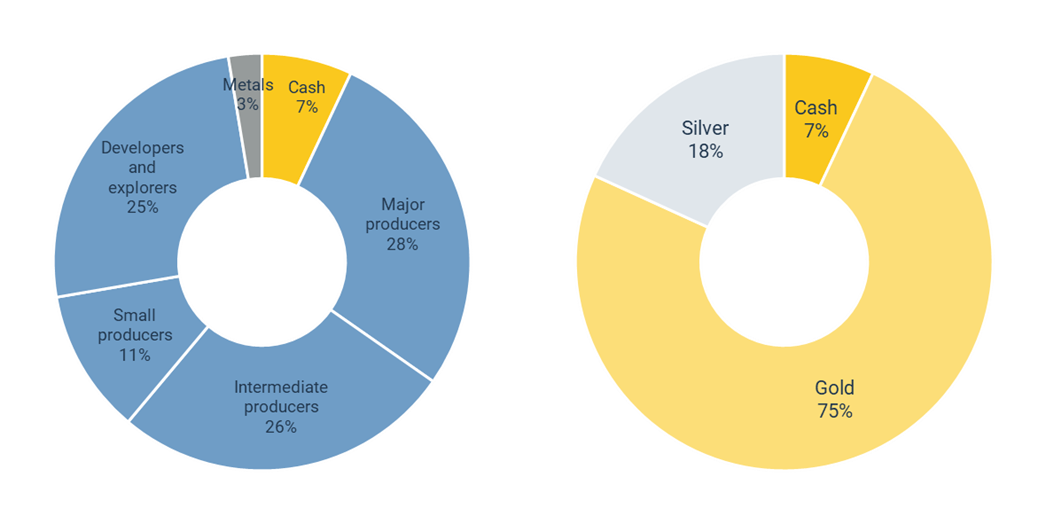
The Konwave Gold Equity Fund is an actively managed strategy focused on investing in gold‑related equities across the mining value chain, including producers, development assets, and exploration companies, with a clear emphasis on small- and mid‑cap opportunities. While gold is the core focus, the strategy retains the flexibility to invest in silver‑related companies.

The fund seeks to exploit inefficiencies within this segment of the market through fundamental, bottom‑up stock selection, where company‑specific factors can drive meaningful differences in outcomes.

Trium and the team

Konwave is a Swiss‑based specialist asset manager focused exclusively on precious metals and natural resource equities since its founding in 1999.

The Konwave Gold Equity Fund is managed by Erich Meier who has over 25 years of experience in commodities investing and has been responsible for the strategy since 2014. He is supported by Konwave founder Walter Wehrli, who brings over three decades of mining sector experience, and by a dedicated technical advisory function led by Andrew Kiep, a senior Canadian geologist, responsible for conducting technical due diligence across all Konwave mining funds.

Investment philosophy and process

Konwave’s investment approach is rooted in the belief that the precious metals mining sector, particularly within small‑ and mid‑cap stocks, remains structurally inefficient and therefore well suited to active management. The team follows a long term, fundamentally driven, bottom‑up process with a strong emphasis on valuation discipline, operating leverage and balance sheet strength.

A growth at reasonable price (GARP) framework is applied to identify companies where growth potential is mispriced. ESG considerations are also an integral part of the team’s research process.

Portfolios are typically constructed using 100–150 holdings, viewed collectively as a diversified basket rather than a small number of concentrated ideas, with stock selection, position sizing and cost discipline forming the core drivers of risk and return. The team maintains a deliberately contrarian stance relative to sell‑side consensus.

This combination of high active share, small‑ and mid‑cap bias and disciplined portfolio construction has historically resulted in the fund’s strongest relative performance during sustained structural bull markets in precious metals equities.

*Asset allocation by segment allocation and metal allocation as of 31st December 2025.[5]

Performance

2025 was an exceptional year for precious metals with gold rising by 65% and silver, 148% (USD terms). As a traditional flight to safety, gold benefited from heightened geopolitical tensions instigated by Trump’s return to the White House. Investors moved assets away from traditional fiat currencies and into gold whilst central banks, particularly the Chinese, continued to stockpile bullion further pushing up prices.

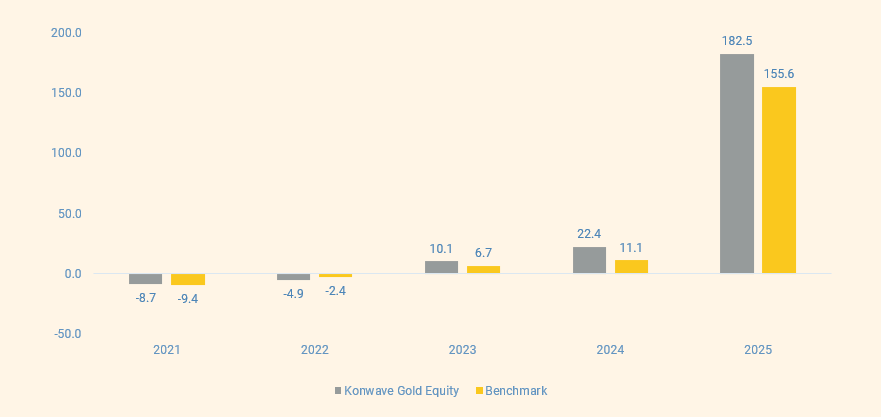
Gold mining equities tend to behave as a high‑beta expression of the underlying gold price due to the operating leverage embedded within miners’ cost structures, so it was unsurprising to see the FTSE Gold Mines Index return 156% (GBP terms) for the year.

Pleasingly, and as outlined in the philosophy, the Konwave Gold Equity fund was well positioned to benefit from the structural bull market given its exposure to the small-, mid- cap, value segment of the market, returning +181% (GBP terms) in 2025 – significantly outperforming its benchmark.

*Performance, %, reflects the Konwave Gold Equity I EUR Fund hedged in GBP as the GBP share class was only launched in 2024. Benchmark performance represents the FTSE Gold Mines Index in GBP.

Source: Saltus, Bloomberg.

Saltus rationale

We see the Konwave Gold Equity fund as best in class, run by a highly skilled manager, demonstrating a clear process that adds value over time. Whilst we seek exposure to precious metals, to provide diversification in our portfolios, we believe Konwave is well positioned to deliver on its mandate.

Asset Allocation Committee

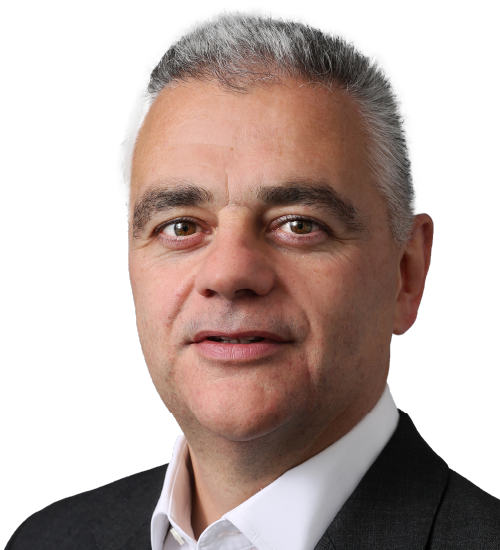
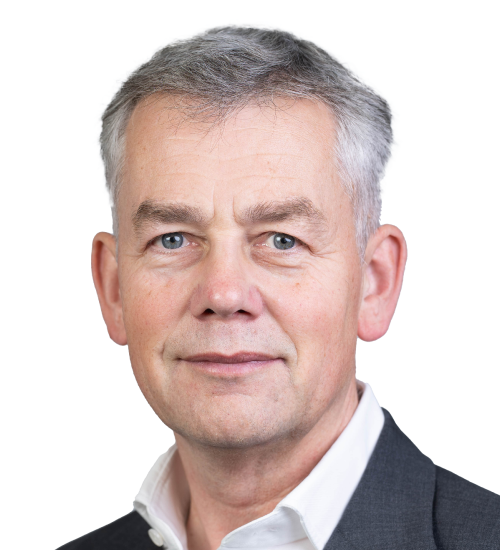
The committee consists of several senior members of the investment team, all partners, who invest their own money alongside clients. The committee consists of:

Article sources

Editorial policy

All authors have considerable industry expertise and specific knowledge on any given topic. All pieces are reviewed by an additional qualified financial specialist to ensure objectivity and accuracy to the best of our ability. All reviewer’s qualifications are from leading industry bodies. Where possible we use primary sources to support our work. These can include white papers, government sources and data, original reports and interviews or articles from other industry experts. We also reference research from other reputable financial planning and investment management firms where appropriate.

The views expressed in this article are those of the Saltus Asset Management team. These typically relate to the core Saltus portfolios. We aim to implement our views across all Saltus strategies, but we must work within each portfolio’s specific objectives and restrictions. This means our views can be implemented more comprehensively in some mandates than others. If your funds are not within a Saltus portfolio and you would like more information, please get in touch with your adviser. Saltus Asset Management is a trading name of Saltus Partners LLP which is authorised and regulated by the Financial Conduct Authority. Information is correct to the best of our understanding as at the date of publication. Nothing within this content is intended as, or can be relied upon, as financial advice. Capital is at risk. You may get back less than you invested. Tax rules may change and the value of tax reliefs depends on your individual circumstances.