Fraud Blocker Saltus 2026 investment outlook | Saltus

Saltus 2026 investment outlook

17 December 2025

Share this article:

Few years have felt quite as dramatic as 2025. We witnessed the return of Donald Trump who came armed with a more aggressive trade policy, geopolitical tensions in multiple regions, political nightmares, and a fair dose of market turbulence. Yet, as we step into 2026, the global economy and financial markets appear surprisingly resilient. Growth is holding up, inflation is behaving, and corporate earnings – especially those linked to artificial intelligence (AI) – continue to advance.

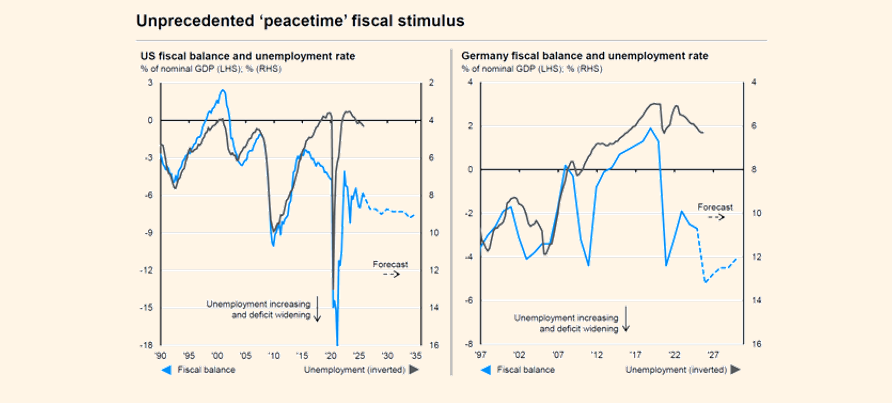
A large part of this has been due to governments and central banks adding stimulus to an already robust global system, and this doesn’t seem likely to go away in 2026.

However, we are also in a world with elevated uncertainty. The inflation problem persists, equity markets remain heavily tilted toward a handful of very large technology companies who have spent and have committed to spend vast amounts of money on AI, government finances are in a precarious position, cracks are emerging in private markets, and we are never far away from another geopolitical flare up. The key challenge for investors in 2026 will not be identifying opportunities – they are plentiful – but navigating the risks with balance, perspective, and a healthy dose of diversification.

The global economy: Surprising strength

Intelligent investing for portfolios over £250k

Find out how to generate risk adjusted returns like a professional...

Going into 2026, the world economy is still showing signs of strength. Global growth is now expected to grow in line with its long-term trend in 2026[1], lifted by a combination of fiscal spending, improving consumer confidence, easier credit conditions, and accelerating investment in new technologies. Never before have we seen fiscal deficits or rate cuts of this magnitude delivered outside of recessions.[2]

The US remains at the heart of this resilience. Trump’s One Big Beautiful Bill will result in significant tax rebates in early 2026.[3] This will boost consumer balance sheets, which have already received a boost from real wage growth, firmer equity markets and rising house prices. Businesses are also investing aggressively, particularly technology companies expanding data-centre capacity and AI infrastructure.[4] This investment boom is feeding directly into economic activity.

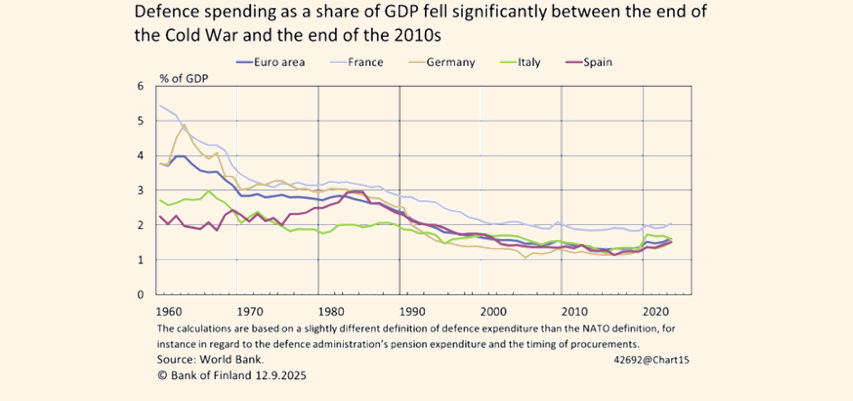
Europe, long seen as the global laggard, may well be one of the positive surprises of 2026. Germany’s vast investment programme is beginning to filter through the economy, supporting everything from infrastructure and manufacturing, to defence. And it’s not just Germany, across the continent, governments are committing to higher military and industrial spending – having pledged to increase military and infrastructure expenditure to 5% of GDP from a low base.[5] While political uncertainty remains part of the European backdrop, especially in France, most of the pressure points are due in 2027, meaning they shouldn’t derail any economic recovery next year.

Japan continues its steady recovery, helped by a supportive central bank and a new prime minister intent on maintaining pro-growth policies.[6] A weak yen and solid export demand should support corporate profits, while ongoing reforms in corporate governance are attracting renewed investor interest.

The one major outlier in this generally positive picture is China. China’s economic performance remains fragile. While the country has launched targeted measures to stabilise the property market and encourage investment, confidence remains muted, both among consumers and companies. The AI breakthrough which started with the emergence of DeepSeek has energised this part of the stock market, but not enough to counterbalance the deeper structural issues. As a result, China’s growth is likely to slow modestly in 2026, even as the rest of the world accelerates.

Inflation: Lower, but set to rise?

Inflation has been the defining macroeconomic story of the last several years, and while it is trending lower, it remains above central bank targets in many major economies. A return to higher inflation is one of the biggest risks going into 2026.

In the US, inflationary pressures have eased significantly from their highs, partly thanks to moderating wage growth and a softening labour market. However, the tariff shock of 2025 is still working its way through the system, and economists caution that a firmer economy in 2026 could lead workers to push for higher pay again.

In Europe, the picture is slightly different. Unlike the US, where further disinflation is expected, the eurozone may be nearing the end of its inflation slowdown. Stronger economic growth, low unemployment, and a fading boost from currency strength all suggest inflation could stabilise or even tick up slightly by late 2026. This is one reason some analysts believe the European Central Bank may ultimately raise rates next year – an unexpected shift compared with market expectations.

The UK is likely to see more meaningful easing in inflation, helped by slower economic activity and constrained consumer spending. That should allow the Bank of England to shift toward a gentler policy stance during the year ahead.

Across Asia, inflation remains generally subdued, which gives countries greater flexibility to ease policy and support growth. This is part of the reason emerging markets look relatively well-positioned heading into 2026.

The overall message is clear: inflation is coming down, and the worst appears behind us. But the world is unlikely to return to the ultra-low inflation environment of the 2010s. Given the monetary and fiscal stimulus expected in 2026, which is coming at a time of resilient economic growth and above-target inflation, rising inflation is one of the most important risks to assess in 2026.

Do you need help managing your investments?

Our team can recommend an investment strategy to meet your financial objectives and give you peace of mind that your investments are in good hands. Get in touch to discuss how we can help you.

Request a call back

looking glass illustration

Monetary Policy: Easing mode, but for how much longer?

Monetary conditions are clearly easing worldwide – but not uniformly, and not dramatically. Interest rates are closer to neutral now.[7] Investors should approach 2026 expecting a gentler policy tailwind than markets currently assume.

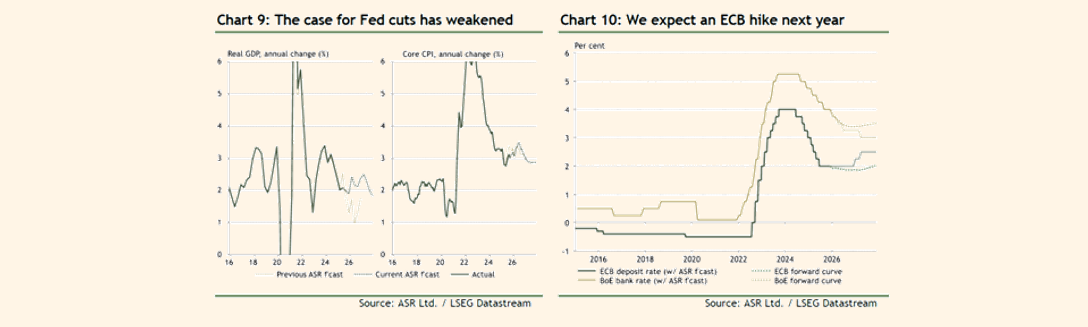
In the US, the Federal Reserve faces a challenging year. Not only must it navigate a damaging mix of persistent inflation pressures and a slowing labour market, but it will also undergo a leadership transition when Jerome Powell steps down in May. Questions around the White House’s influence on future appointments have already prompted debate about the Fed’s independence. If markets come to believe that policy decisions are being shaped by political considerations, the US dollar could weaken significantly. Still, most analysts expect the Fed to cut interest rates in 2026, but not dramatically – perhaps only once or twice – given growth and inflation dynamics.[8]

This is a clear contrast to the outlook in Europe. With economic conditions improving, governments spending, and inflation potentially rising, the ECB may ultimately need to raise rates slightly if inflation re-accelerates.

Source: Absolute Strategy Research – Economic Outlook 2026

In the UK, the case for further easing has become clearer given a weak economy and labour market. Restrictive fiscal policy (tax rises and spending cuts) may increase the need for supporting monetary policy.

Japan remains the global exception, where interest rates are expected to stay near zero for the foreseeable future, sustaining a powerful source of cheap capital for global markets.

AI: Show me the money

No 2026 outlook could omit a section on AI, and indeed our whole outlook for 2026 could hinge on how the AI boom plays out. The AI arms race shows no signs of slowing. Companies are pouring hundreds of billions of dollars into building datacentres, training large language models, expanding semiconductor capacity, and reinforcing electricity grids. The scale of infrastructure required is staggering – one estimate suggests $7tn will need to be invested in data centres by 2030 to keep up with AI demand.[9]

Already, these capital expenditures are having a noticeable impact on the macroeconomic data, especially in the US. The AI story is therefore much more than just an equity market story.

This AI-led capex cycle is boosting earnings in technology, industrials, energy infrastructure, and even materials. Semiconductor firms, cloud providers, hyperscalers, robotics companies, power utilities, and equipment manufacturers all stand to benefit.

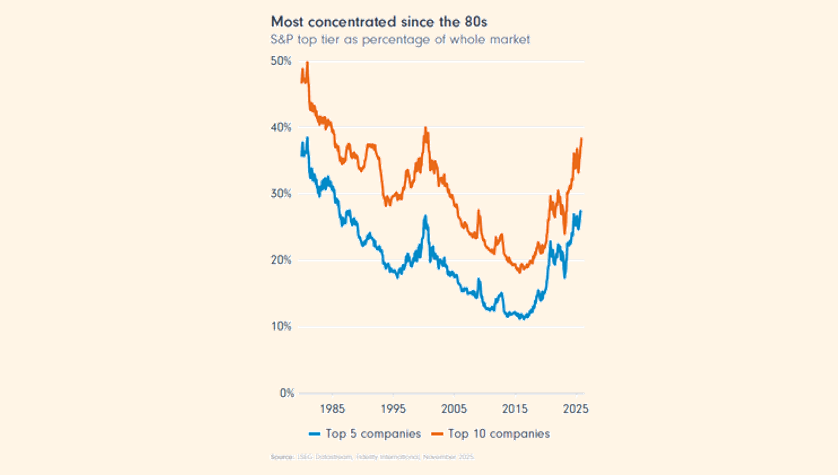
The obvious risk here is the extreme concentration at the top of the US stock market. The S&P500 equity index is estimated to now have 44% of its market capitalisation in AI stocks.[10] The largest American technology companies now dominate not only indices but also investor psychology.[11]

Source: Fidelity International 2026 Outlook

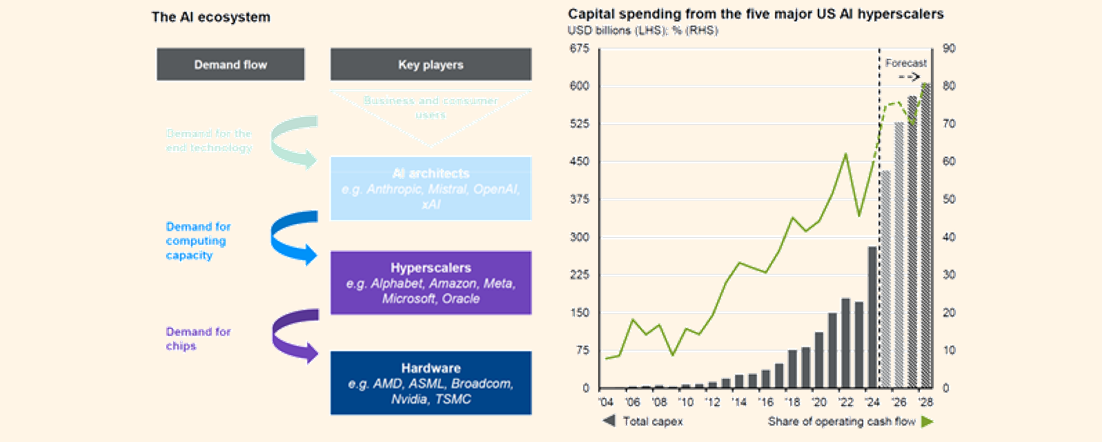
The biggest winners so far have been the hyperscalers (e.g. Meta, Google, Amazon, Microsoft, Oracle) – the companies that provide the computing capacity at their datacentres, and the hardware suppliers (e.g. Nvidia, TSMC, ASML, Broadcom). The companies that provide the AI models we currently use (e.g. OpenAI runs ChatGPT) buy computing capacity from the hyperscalers. The hyperscalers then buy Nvidia’s chips, among other things, to build out this capacity.

Source: (Left) J.P. Morgan Asset Management. (Right) Bloomberg J.P. Morgan Asset Management. The chart shows the total company capex for Alphabet, Meta, Microsoft and Oracle, as well as an estimate of Amazon’s AWS spend. Operating cash flow represents cash flow before capital expenditures. Guide to the Markets – EMEA, Data as of 28 November 2025.

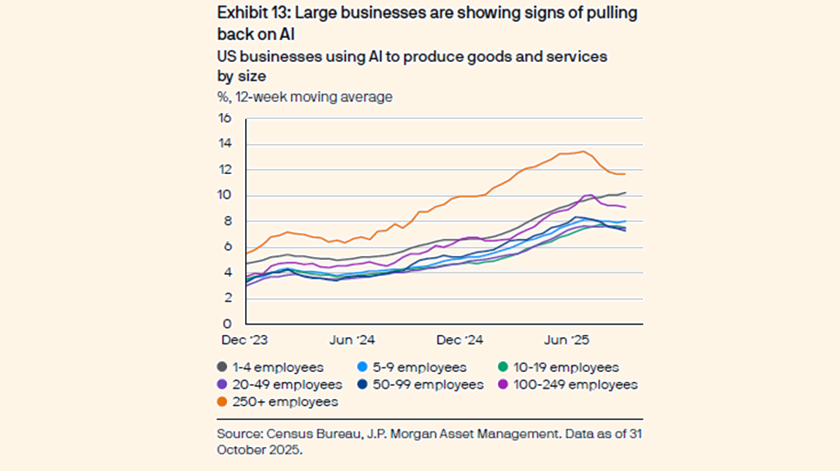
So far, the revenue and profit has accrued to the hyperscalers and the hardware suppliers. The more important aspect to watch is the adoption and spending on AI models from the end users. Currently consumers can access most AI models for free. The big question is around how much businesses are willing to spend on AI to enhance their profitability, as this is the foundational source of demand for the whole AI ecosystem. It will be important to follow commentary from corporate management teams around how much they are willing to spend on AI, as this will impact whether the AI giants can earn a return on their vast investments. This aspect of the AI story is more cyclical, because if there is an economic slowdown, companies may reduce their spending on finding new ways of working. Already we are seeing large businesses showing signs of pulling back on AI.

Equities: Constructive, but be careful where you look

The stage is set for equity markets to have another constructive year. Global growth is firm, inflation is well-behaved, and AI continues to drive structural demand (for now). Yet equity investors must tread carefully.

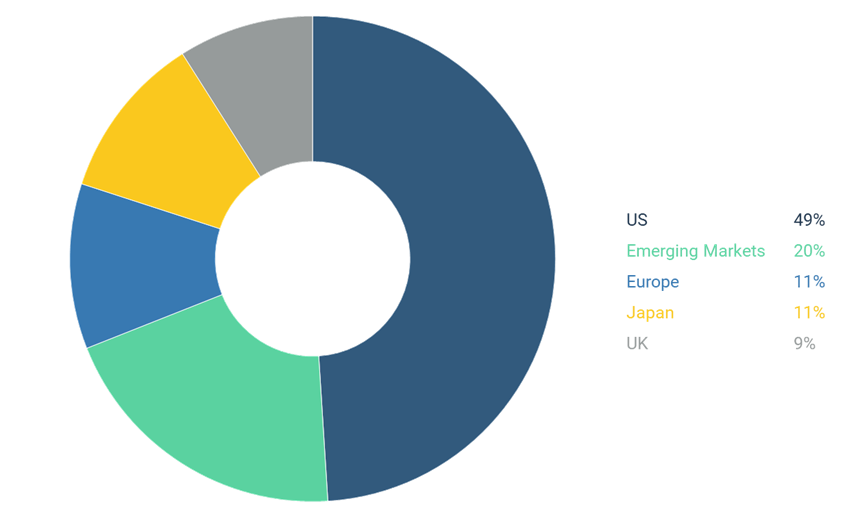
The US remains the world’s growth engine, and US equities will continue to be central to global portfolios. However, their dominance is also a source of risk given the overdependence on one narrative. We currently have around half of our equity book exposed to the US, which we feel is the right balance given the opportunities and risks. Within our US equity position, we have intentionally sought to diversify our exposure so we are not overexposed to the AI theme.

In contrast, Europe looks increasingly attractive. Valuations are more compelling, stimulus is coming, and the earnings cycle is turning upward. Germany’s investment programme is likely to boost manufacturing and industrial activity, while higher defence spending across the continent will support specific sectors. For investors seeking diversification away from US technology, Europe offers a broad landscape of high quality companies with steadier performance patterns.

Japan continues its multiyear transformation, with corporate governance reforms driving improved shareholder returns and a supportive policy environment encouraging business investment. The new Japanese prime minister has unveiled a fiscal package worth 3% of GDP.[12] This potent mix could mean that Japanese equities are poised to benefit, and so they remain one of our core non-US equity positions.

Another core region for us is emerging and frontier markets. Emerging markets offer a mixed but promising picture. Countries like India and Brazil stand out for strong fundamentals, attractive real yields, and favourable structural trends. Several Asian markets – especially Korea and Taiwan – are central players in the semiconductor and AI supply chains. China remains more challenging, but selective opportunities are emerging as the government gradually stabilises property markets and encourages innovation.

Overall, equity markets still offer an attractive upside but success in 2026 will rely on broad diversification, careful regional and sector selection, and a willingness to venture beyond the narrow cadre of U.S. megacap technology firms.

Saltus Global Equity Fund regional allocation at 31 October 2025

Bonds: Another year of conflicting forces

Bond markets face a more complicated year. On one hand, central banks are moving toward easier policy, which typically supports short-dated fixed income. On the other hand though, nominal GDP growth remains strong, and governments are running historically large deficits. These factors tend to push yields higher, particularly on longer-dated bonds. This may result in steeper yield curves.

For this reason, we remain cautious on long-dated government bonds. If inflation surprises on the upside or if markets question government fiscal responsibility – particularly in the US, Japan and UK – long term yields could rise.

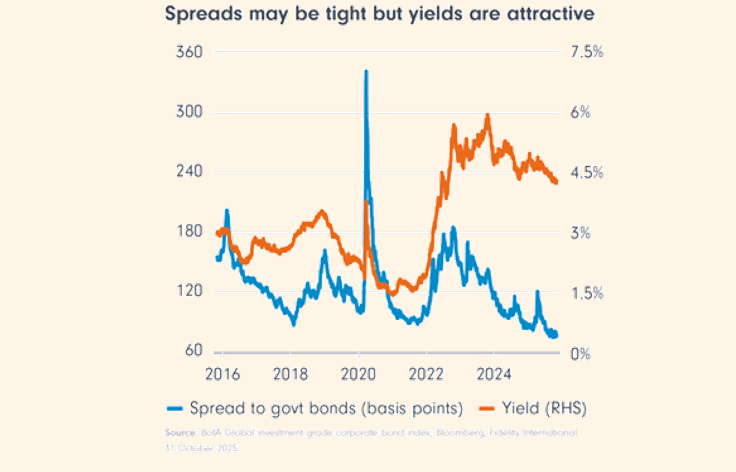
Credit markets, however, look more promising. Corporate balance sheets remain healthy, and default risks remain contained. Shorter-dated credit offers attractive yields with less sensitivity to interest rate movements, and high-yield bonds continue to benefit from favourable corporate fundamentals. Emerging-market local-currency debt is also attractive, especially where inflation has stabilised and real yields remain high.

Source: Fidelity International 2026 Outlook

The message is that 2026 will reward flexible, selective, and globally diversified fixed-income portfolios rather than broad exposure to duration-heavy government bonds.

A changing world: Be alternative

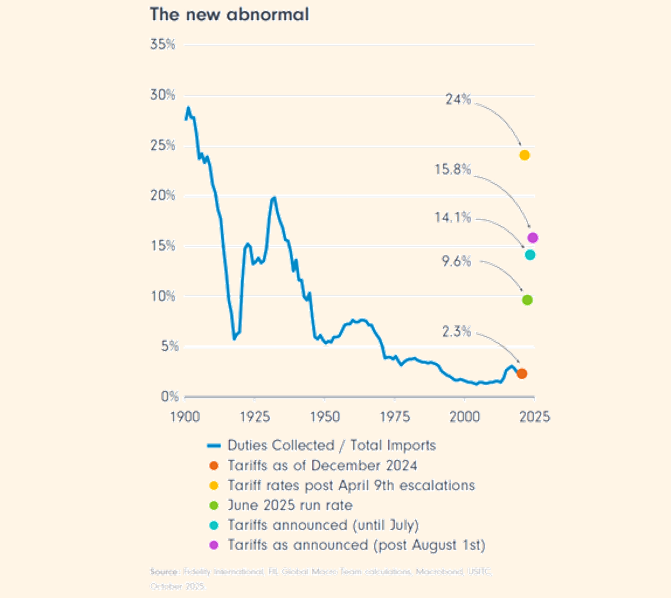
Beyond the economic and market fundamentals mentioned above, 2026 may be shaped by deeper structural changes. Global fragmentation continues to reshape trade, supply chains, and currency dynamics. Tariffs are now at their highest level in decades (the chart below shows where US tariffs could settle), and countries are increasingly prioritising domestic production and energy security. This environment creates new winners and losers, and investors must adapt to a world that is less integrated than the one that prevailed over the past 30 years.

Source: Fidelity International 2026 Outlook

Another important theme is the merging of fiscal and monetary policy. Many governments have effectively stepped in to support their economies with aggressive spending, even without recessionary conditions. This marks a shift away from the restraint that defined much of the post-financial-crisis era. It also increases the odds that inflation remains somewhat higher than before.

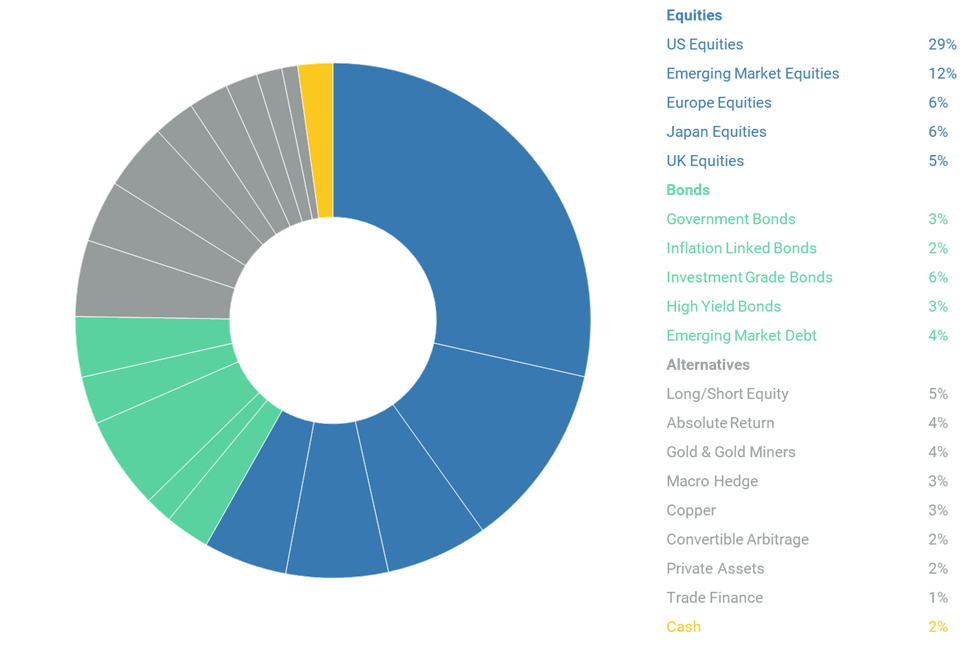
Finally, markets must contend with rising geopolitical uncertainty. From shifting trade alliances to political changes in major economies, the global landscape is more fluid than it has been in decades. As we’ve seen in 2025, it is impossible to forecast the path of many of these issues, and of course new areas of risk will emerge in 2026. For this reason, we believe alternative asset classes are essential in multi-asset portfolios to increase diversification in the face of these uncertainties. Gold, copper, private assets, and absolute-return strategies are just some of the alternatives we invest in and will play an increasingly important role in managing risk and diversifying returns in 2026.

Saltus Multi Asset Class Balanced with Private Assets model asset allocation at 31 October 2025

Final thoughts: Stay invested, but stay balanced

The world going into 2026 may feel unsettled, as 2025 has been, but it is also full of opportunity. Global growth is robust, investment cycles are strengthening, and technological innovation is reshaping entire industries. At the same time, inflation remains sticky, central banks are approaching policy shifts cautiously, and financial markets face concentration risks and geopolitical challenges.

For Saltus portfolios, the key is balance. Staying invested remains essential, because cash alone cannot capture the opportunities created by innovation and growth. But diversification – across regions, sectors, asset classes, and investment styles – is equally important, particularly when markets are increasingly reliant on a small number of companies.

2026 is another year to embrace opportunity without abandoning discipline. By combining a global perspective with selective positioning, our investors can navigate the complexities of the year ahead with confidence and clarity.

Do you need help managing your investments?

Our team can recommend an investment strategy to meet your financial objectives and give you peace of mind that your investments are in good hands. Get in touch to discuss how we can help you.

Request a call back

looking glass illustration

Article sources

Editorial policy

All authors have considerable industry expertise and specific knowledge on any given topic. All pieces are reviewed by an additional qualified financial specialist to ensure objectivity and accuracy to the best of our ability. All reviewer’s qualifications are from leading industry bodies. Where possible we use primary sources to support our work. These can include white papers, government sources and data, original reports and interviews or articles from other industry experts. We also reference research from other reputable financial planning and investment management firms where appropriate.

The views expressed in this article are those of the Saltus Asset Management team. These typically relate to the core Saltus portfolios. We aim to implement our views across all Saltus strategies, but we must work within each portfolio’s specific objectives and restrictions. This means our views can be implemented more comprehensively in some mandates than others. If your funds are not within a Saltus portfolio and you would like more information, please get in touch with your adviser. Saltus Asset Management is a trading name of Saltus Partners LLP which is authorised and regulated by the Financial Conduct Authority. Information is correct to the best of our understanding as at the date of publication. Nothing within this content is intended as, or can be relied upon, as financial advice. Capital is at risk. You may get back less than you invested. Tax rules may change and the value of tax reliefs depends on your individual circumstances.

More from Saltus...

About Saltus?

Find out more about our award-winning wealth management services…

Winner

Top 100 Financial Advisers

Winner

Best Wealth Manager

Winner

Investment Performance: Cautious Portfolios

Winner

Top 100 Fund Selectors 2024

Winner

Top 100 Financial Advisers

Winner

Best Wealth Manager

Winner

Investment Performance: Cautious Portfolios

Winner

Top 100 Fund Selectors 2024

£9.7bn+

assets under advice

20

years working with clients

450+

employees

97%

client retention rate

£9.7bn+

assets under advice

20

years working with clients

450+

employees

97%

client retention rate